

Milling Machine T-Nuts — Sizes, Types & How to Choose the Right One
The T-nut is the anchor of every clamping setup. It sits inside the machine table T-slot and takes the full axial load of the clamping stud. Specify the wrong size and it won't seat correctly. Specify the wrong material grade and it fails in the slot — and a seized T-nut in a precision machine table slot is an expensive repair. Madras Engineering Works supplies ISO 9001:2015 certified hardened T-nuts for all standard VMC T-slot sizes from stock in Chennai.
The Three Standard Milling Machine T-Nut Sizes
| T-Slot Width | Thread Size | Common Machine | MEW Part |
|---|---|---|---|
| 12mm | M10 | FANUC ROBODRILL, small bench mills | T1-TN-1210 |
| 14mm | M12 | BFW BMV, ACE MCV, Jyoti VMC, Lokesh, KENT | T1-TN-1412 |
| 16mm | M16 | Haas VF-1/2/3/4/5, larger HMC machines | T1-TN-1616 |
To confirm the T-slot size on your specific machine model, see the T-slot size guide which covers BFW, ACE, Jyoti, Haas, FANUC ROBODRILL, and all major Indian and imported VMC brands.
Standard vs Hardened T-Nuts: Why Grade Matters
Many Indian tool rooms buy T-nuts from hardware stores or general fastener suppliers. These are typically mild steel with zinc plating. Under the clamping loads applied in VMC milling — a correctly torqued M12 stud applies roughly 35–40 kN of clamp force — a mild steel T-nut deforms at the thread bore. The bore walls crush slightly. The T-nut seizes in the slot. Removing it requires tapping it out and risks damaging the precision-ground T-slot walls.
A hardened T-nut at 24–32 HRC does not deform at the bore under VMC clamping loads. The thread remains true after thousands of cycles. The T-nut slides in and out of the slot cleanly throughout the fixture's service life.
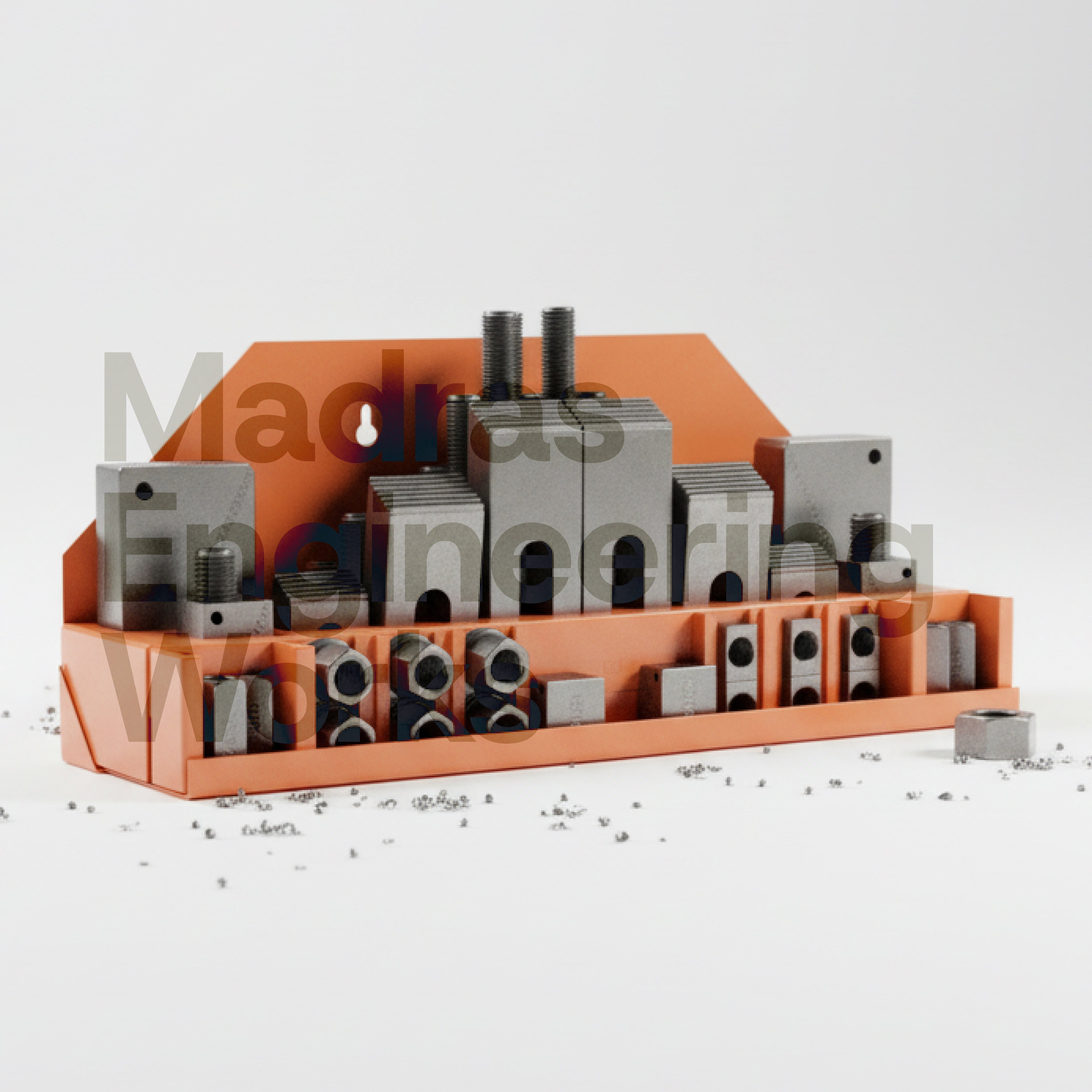
Madras Engineering Works supplies hardened medium carbon steel T-nuts, chemically blackened, manufactured to IS standards, ISO 9001:2015 certified. These are the T-nuts included in all MEW clamping kits.
T-Nut Types for Milling Machines
Standard Rectangular T-Nut
The most common type. A rectangular body with a tapped centre bore. Inserted from the end of the T-slot. Sits flat in the slot. This is the correct choice for all standard VMC and milling machine setups.
Rhombus (Diamond) T-Nut
A rhombus-shaped body that can be inserted into the T-slot from the top by passing through the narrow opening at 45 degrees, then rotating 90 degrees to lock. Used where end-loading the slot is not possible — rotary table T-slots, dovetail slides, and some compact machining centre tables where the slot has no accessible end.
Moveable T-Nut (Sliding T-Nut)
Designed to slide freely along the T-slot so the stud position can be adjusted laterally without removing the nut. Used in flexible fixturing systems and production VMC fixtures where setup adjustments are frequent.
Machine Compatibility Table
| Machine | T-Slot Width | T-Nut Thread | T-Nut Body Width |
|---|---|---|---|
| BFW BMV 40 | 14mm | M12 | 13.8–13.9mm |
| BFW BMV 45/50 | 14mm | M12 | 13.8–13.9mm |
| ACE MCV 450/500 | 14mm | M12 | 13.8–13.9mm |
| Jyoti VMC 430/550 | 14mm | M12 | 13.8–13.9mm |
| Lokesh VMC 40/45 | 14mm | M12 | 13.8–13.9mm |
| KENT VMC | 14mm | M12 | 13.8–13.9mm |
| FANUC ROBODRILL | 12mm | M10 | 11.8–11.9mm |
| Haas VF-1 | 16mm | M16 | 15.8–15.9mm |
| Haas VF-2/3/4/5 | 16mm | M16 | 15.8–15.9mm |
Note: T-nut body width must be 0.1–0.2mm less than the T-slot width to slide freely. If too tight, the T-nut seizes in the slot. If too loose, it rocks and clamping force is off-axis.
Why the T-Nut Body Width Matters
A T-nut body that is 0.5mm narrower than the slot will rock laterally when the stud is torqued. This creates an off-axis clamping load — the stud pulls slightly to one side. Under heavy cutting force, the nut rocks further, stud preload drops, and the workpiece can shift.
A T-nut that is slightly oversize will not slide into the slot, or will seize partway along. An oversize T-nut forced into a slot by hammer can score the precision-ground slot walls.
All T-nuts from Madras Engineering Works are manufactured to the correct body width tolerance for the corresponding slot width. ISO 9001:2015 certified dimensional inspection before dispatch. This is why MEW T-nuts slide cleanly and hold accurately — they are made to specification, not to a rough approximation.
Ordering & Support
To find the right T-nut for your machine, use the Smart-Spec calculator — enter your machine model and get the correct T-slot size, T-nut part number, and stud thread in 30 seconds. Or WhatsApp +91 95143 73702 with your machine model and we'll confirm before dispatch. Madras Engineering Works is an ISO 9001:2015 certified industrial supplier, Chennai. Same-day dispatch available.
Frequently Asked Questions
What T-nut size fits my milling machine?
The three standard T-slot widths on Indian VMC and milling machine tables are 12mm, 14mm, and 16mm, corresponding to M10, M12, and M16 thread T-nuts respectively. BFW, ACE, Jyoti, KENT, and Lokesh VMCs typically use 14mm T-slots with M12 T-nuts. FANUC ROBODRILL uses 12mm with M10. Haas VF series uses 16mm with M16. Measure the slot opening with a steel rule to confirm.
What is the difference between a standard and hardened T-nut?
A standard mild steel T-nut deforms at the thread bore under VMC clamping loads, causing the T-nut to seize in the slot and the thread to strip. A hardened T-nut (24–32 HRC, medium carbon steel) maintains thread integrity and bore geometry through thousands of clamping cycles. Madras Engineering Works supplies ISO 9001:2015 certified hardened T-nuts for all standard sizes.
What thread size do milling machine T-nuts have?
12mm T-slot = M10 thread. 14mm T-slot = M12 thread. 16mm T-slot = M16 thread. The T-slot width and stud thread must always match. Mismatched combinations either won't assemble or will cause the T-nut to sit off-centre in the slot.
What is a rhombus T-nut used for?
A rhombus T-nut is inserted into the T-slot from the top rather than the end — by passing it through the narrow opening at 45 degrees, then rotating 90 degrees to lock. Used in rotary table T-slots, dovetail slides, and compact machining centres where the slot has no accessible end for conventional end-loading.
How many T-nuts should I have per machine?
Provision 2–3 T-nuts per clamping stud position in your most complex typical setup, plus 30% spare. A standard 58-piece MEW clamping kit includes sufficient T-nuts for typical 4–6 stud setups. Replace T-nuts when threads show deformation, when the body width has been scored, or when the nut no longer slides freely in the slot.
Written by Husain, Founder of Madras Engineering Works — ISO 9001:2015 certified industrial supplier in Chennai. WhatsApp +91 95143 73702 or email enquiry@madrasengg.com.


0 comments