

If you’ve ever struggled with vibration marks, uneven finish, or a workpiece that shifts mid-operation, the real culprit is often one thing: poor clamping.
In CNC machining, clamping elements are not accessories — they are the foundation of accuracy, safety, and productivity.
Before we begin, explore our full range of clamping solutions here:
👉 Clamping elements
What Are Clamping Elements?
Clamping elements are mechanical devices used to hold a workpiece securely in place during CNC machining — milling, drilling, tapping, or turning.
Their purpose is to:
-
Prevent movement
-
Maintain dimensional accuracy
-
Resist cutting forces
-
Protect operators & machines
Without proper clamping, even the most advanced CNC machine can create scrap.
Why Clamping Matters in Indian CNC Workshops
Across India — Chennai, Coimbatore, Rajkot, Pune, Hyderabad — workshops face:
-
Frequent job changeovers
-
Varied part sizes
-
Tight production deadlines
-
Budget constraints
This is why modular clamping systems are preferred — especially:
-
T-bolts 👉 View Catalogue
-
U-clamps 👉 View Catalogue
-
Strap clamps 👉 View Catalogue
-
Step blocks 👉 View Catalogue
Types of Clamping Elements (Used Across India)
Below are the most common clamping devices used on CNC/VMC/HMC machines:
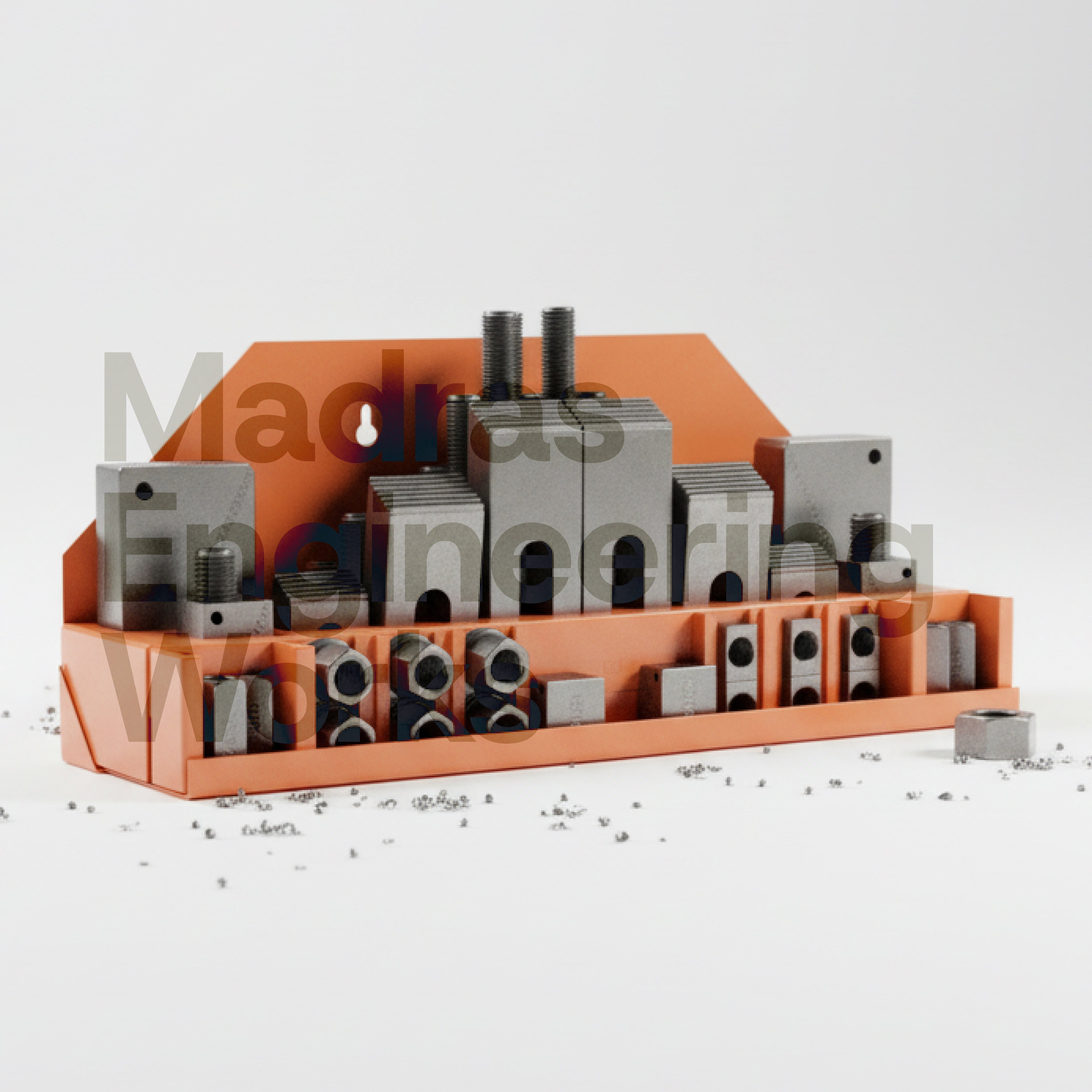
1. Flat Strap Clamps / Strap Clamps
-
Ideal for flat workpieces
-
Cost-effective & versatile
-
Very popular in job shops
2. Step Blocks + Step Clamps
-
Useful for height adjustments
-
Ideal for uneven workpieces
3. T-Bolts / T-Slot Studs
-
Fit into the machine’s T-slots
-
Core of every modular clamping kit
4. U-Clamps
-
Rigid top-down clamping
-
Great for milling setups
Technical Factors That Affect Clamping
✔ Clamping Force
Too low → vibration
Too high → deformation
✔ Clamp Material
-
Mild Steel
-
Alloy Steel
-
SG Iron
-
Black-Oxide finished clamps
✔ Compatibility with Machine Table
Add a link to your T-slot accessories here:
👉 View Catalogue
Real Use Cases in Indian Workshops
1. Job Shops (Tamil Nadu / Maharashtra)
Use:
-
Strap clamps 👉 View Catalogue
-
T-bolts 👉 View Catalogue
-
U-clamps 👉 View Catalogue
2. Automotive Manufacturers
Use hydraulic/pneumatic clamps
3. Precision Industries
Use:
-
Centering clamps
-
Wedge clamps
Common Clamping Problems in India (And Their Fixes)
❌ 1. Inconsistent Force
Fix: Use good-quality T-bolts & studs
👉 View Catalogue
❌ 2. Workpiece Slippage
Fix: Use step blocks or strap clamps
👉 View Step Block Set
👉 View Flat Strap Clamps
❌ 3. Using Cheap or Worn Clamps
Fix: Use hardened alloy clamps
👉 View Clamping Elements
❌ 4. Compatibility Issues
Fix: Match T-slot size with:
👉 View T-Bolt Catalogue
How to Choose the Right Clamping Element
1. Choose Based on Geometry
-
Flat part → Flat Strap Clamp
-
Tall part → Step Blocks 👉 View Step Block Set
-
Round part → Centering Clamps
-
Delicate part → Vacuum Plates
2. Choose Based on Force
Alloy steel clamps → heavy milling
MS clamps → general machining
Link category here:
👉 View Clamp Catalogue
3. Production Requirement
Manual clamps → job shops
Hydraulic clamps → mass production
Alternatives & When to Use Them
| Type | Use | |
|---|---|---|
| Manual Clamps | General machining |
|
| Hydraulic/Pneumatic | Batch jobs | |
| Vacuum/Magnetic | Delicate parts | |
| Centering/Wedge | Precision machining |
Safety & Maintenance Tips
To keep clamps safe and long-lasting:
-
Inspect regularly
-
Lubricate threads
-
Replace worn studs
-
Train operators on force and torque
You can link this line:
👉 High-quality T-Bolts / Stud Sets
Conclusion
Clamping elements may look simple — but they control:
-
Accuracy
-
Finish
-
Tool life
-
Production time
-
Operator safety
If you want reliable machining performance, start with reliable clamping.
Explore high-quality clamping solutions here:
👉 View Clamp Catalogue


0 comments