
Strap Clamp Types for Milling Machines: Which One for Your Setup (India Guide)
Walk into any Indian tool room and you will find one type of strap clamp in the drawer. Walk into a well-equipped one and you will find eight. The difference matters — the wrong strap clamp type for your milling machine is how jobs slip mid-cut, how setups take twice as long as they should, and how fixtures get bodged with improvised solutions that never quite work. This guide covers every strap clamp type in MEW's catalogue, with verified specs and clear guidance on which situation each one was designed for.
The Eight Strap Clamp Types: Overview
| Clamp Type | SKU | Defining Feature | Primary Use Case |
|---|---|---|---|
| Plain Clamp | T1-PC-1170 | Straight, smooth underside | General-purpose flat workpieces |
| Serrated Strap Clamp | T1-SSC-960 | Toothed underside + step block system | Slip-prone materials; height-indexed setups |
| Flat Strap Clamp | T1-FSC-960 | Low profile, thin cross-section | Multi-fixture pallet setups; low clearance |
| Slotted Clamp | T1-SC-1175 | Elongated bolt slot (adjustable position) | Variable workpiece sizes; flexible stud placement |
| Goose Neck Clamp | T1-GNC-11100 | Offset S-curve body | Raised bosses, obstructions, die/casting work |
| U-Clamp | T1-UC-11100 | U-shaped body, two contact points | Anti-rocking; confined fixture layouts |
| Double Ended Clamp | T1-DEC-1160 | Two clamping ends, one stud | Two clamp points in a confined space |
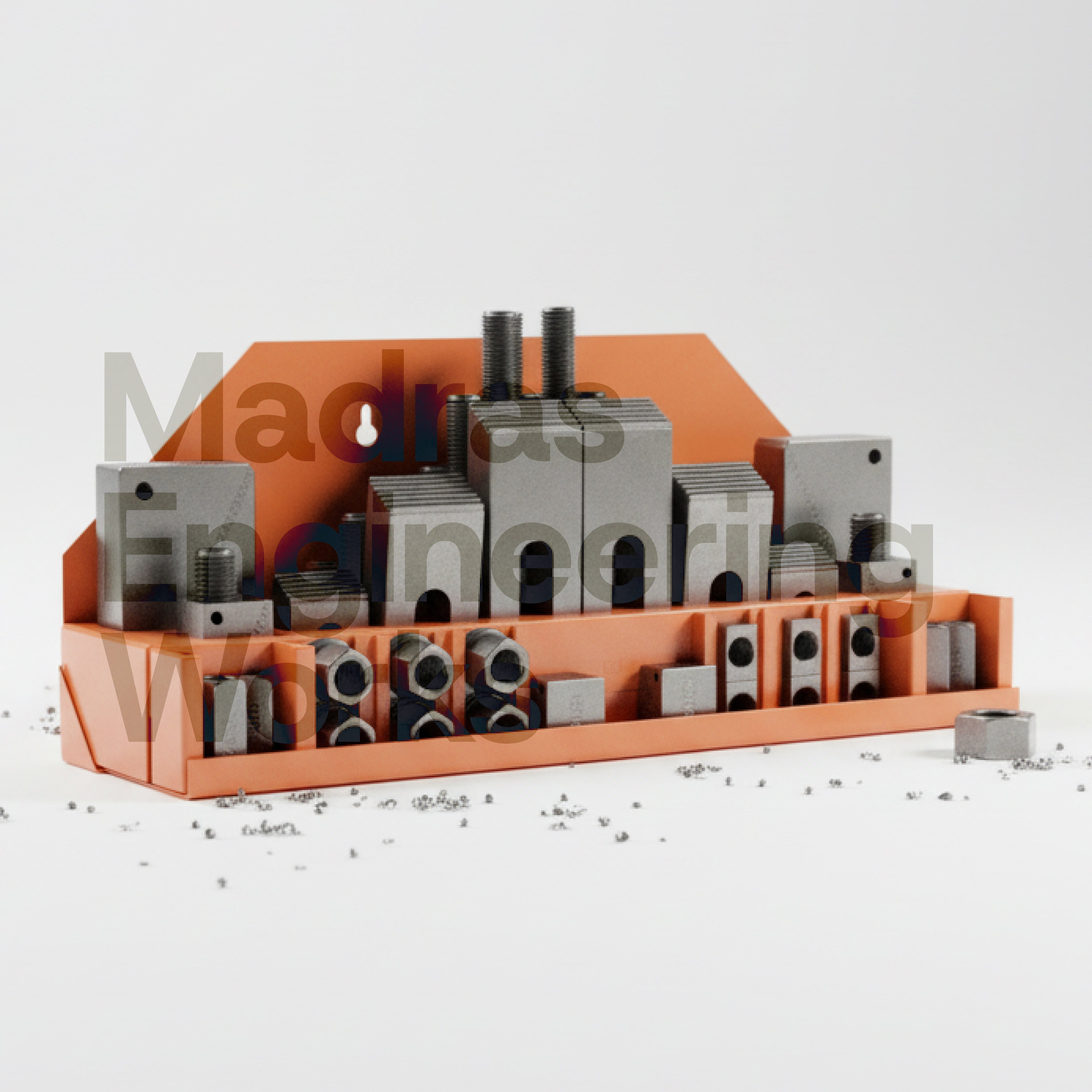
| Press Tool / Milling Clamp (PTMC) | T1-PTMC-8 | S.G. Iron pad + swivel nut, heavy-duty rated | Press dies, heavy milling, castings |
Plain Clamp (T1-PC-1170): The Baseline
The plain strap clamp handles the majority of general-purpose workholding on flat or near-flat components in CNC and conventional milling.
- Use for: Flat steel, cast iron, or aluminium workpieces on standard VMC or milling tables
- Do NOT use for: Aluminium or stainless with smooth surfaces (slip risk) — use Serrated instead. Components with raised bosses blocking straight access — use Goose Neck. Heavy press tool or die clamping — use PTMC.
Serrated Strap Clamp (T1-SSC-960): Anti-Slip + Height-Index System
The serrated clamp does two things: the toothed face bites into the workpiece surface, developing mechanical interlock instead of relying on friction. If you've ever had a part shift under a strap clamp during an aluminium roughing cut, this prevents it.
The second function: the Serrated Strap Clamp (T1-SSC) is designed to pair with MEW's Universal Serrated Blocks (T3-USB). The serrations on the clamp's heel end match the serrations on the block's steps. When engaged, the clamp locks at a precise height increment — no shimming, no wobble, no gap in the step stack. This is a paired height-index system, not just a clamp with a texture.
Not sure if your workpiece material needs serrated clamping? WhatsApp a photo of your setup to +91 95143 73702.
Slotted Clamp (T1-SC-1175): When Your Workpiece Doesn't Match Fixed-Hole Geometry
A plain clamp has its stud hole at a fixed position. The slotted clamp has an elongated slot instead — you can position the stud anywhere along the slot's range, adapting to whatever edge distance your workpiece presents. Right choice for job shop and tool room environments handling diverse workpiece sizes, prototyping work, and any setup where stud-to-edge distance varies between jobs.
Goose Neck Clamp (T1-GNC-11100): Reaching Over Obstacles
A gooseneck clamp is an offset clamp. The S-curve body raises the stud engagement zone above the workpiece contact end, allowing the clamp to bridge over a raised boss, adjacent fixture wall, or workpiece feature that would block a straight clamp. The body arcs upward over the obstacle then back down to contact the workpiece — the clamping point is lower relative to the high point of the clamp body.
- Use for: workpieces with raised bosses or walls near the clamping point, adjacent fixture components blocking straight clamp access, press tool dies and large castings with irregular surfaces
U-Clamp (T1-UC-11100): Two-Point Stability from One Clamp
The U-clamp's U-shaped body bridges over the workpiece and applies force from two sides simultaneously. From a single stud, you get two constraint points instead of one — eliminating the rotation mode that a single clamping point allows under asymmetric cutting forces. In tight fixture layouts, two adjacent strap clamps may not fit side by side; a U-clamp provides equivalent two-point constraint in the footprint of a single clamp.
Double Ended Clamp (T1-DEC-1160): Two Clamping Points, One Component
Two independent clamping ends — one at each end of a single body — sharing one stud and one nut. The compact solution for fixtures where two clamping points are needed but space or cost prevents two separate clamps.
Press Tool / Milling Clamp — PTMC (T1-PTMC-8): Heavy-Duty Die and Casting Work
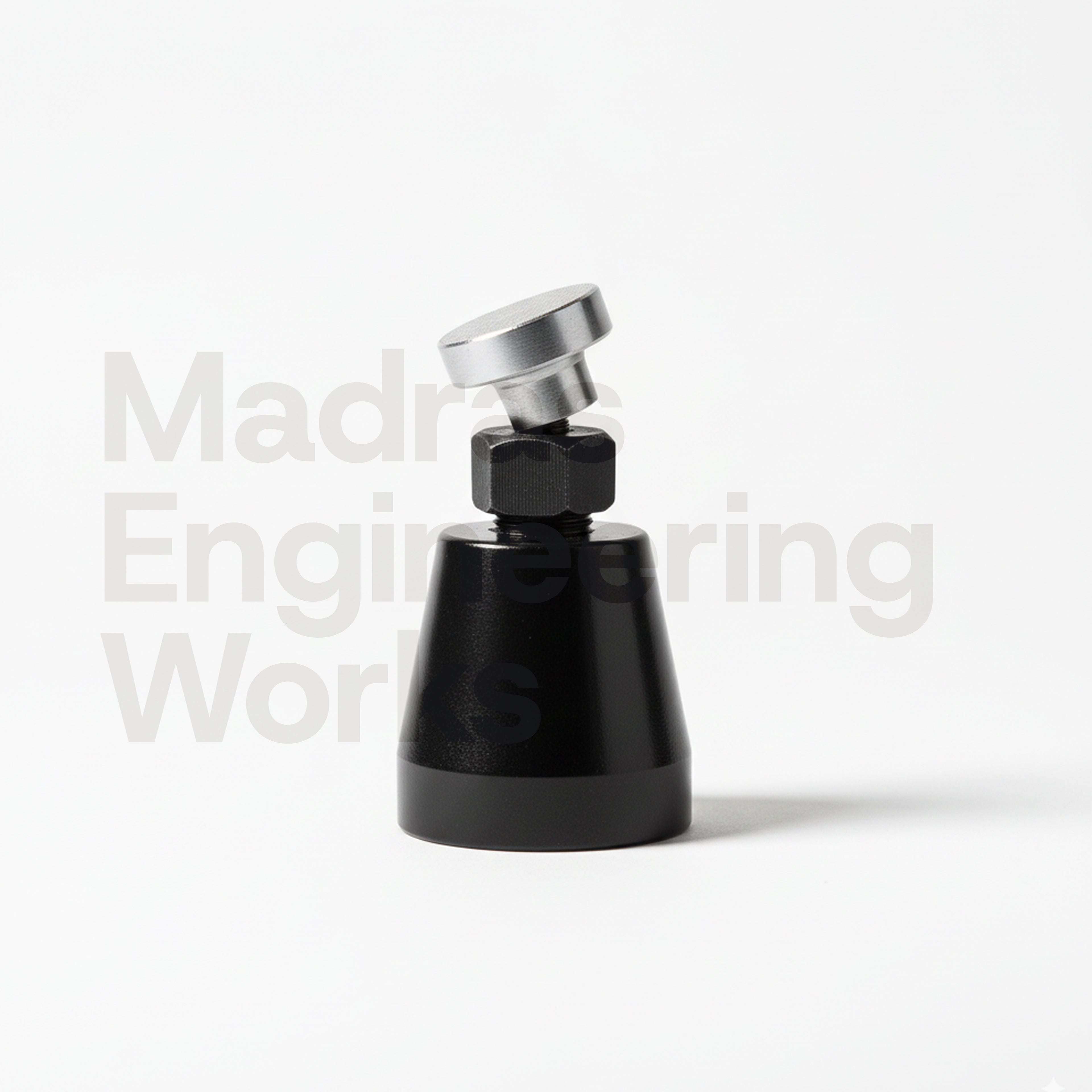
The PTMC is rated for press tool die clamping and heavy milling where standard clamps reach their load limits. The key feature is the swivel nut: it self-aligns to whatever angle the pad needs to sit fully flat. On worn machine tables and press platens, a fixed nut risks line-contact at the pad edge — concentrating force and risking pad damage at press clamping loads. The swivel nut ensures full face contact across the entire pad area.
- Clamping pad: High Tensile S.G. Iron, enamelled flame red
- T-bolt and high nut: medium carbon steel, 24–32 HRC, chemically blackened
- Applications: press tools and dies; machine bed clamping for flat components and castings
Quick Clamp (T1-QC-1/12) and Mould Clamp (T1-MCH-12115-S)
Quick Clamp: For job shops and small-batch environments with frequent workpiece changeover. Supplies a complete assembly — clamp, saddle, T-bolt, and flanged hex nut — in one ready-to-install unit.
Mould Clamp: For injection moulding machine platen clamping only. Includes a heavy integral support bolt — no separate step block needed. Do not substitute with standard strap clamps in injection moulding applications. Compatible with Haitian, L&T, Toshiba, Arburg, Engel, Fanuc, and all other major IMM brands.
Selection Summary
| Situation | Choose This Clamp | SKU |
|---|---|---|
| Flat workpiece, standard general milling | Plain Clamp | T1-PC-1170 |
| Aluminium, stainless, or slippery surface material | Serrated Strap Clamp | T1-SSC-960 |
| Multi-fixture pallet / low overhead clearance | Flat Strap Clamp | T1-FSC-960 |
| Variable workpiece sizes, stud position must adjust | Slotted Clamp | T1-SC-1175 |
| Raised boss or obstruction blocking straight clamp | Goose Neck Clamp | T1-GNC-11100 |
| Anti-rocking; two contact points in confined space | U-Clamp | T1-UC-11100 |
| Two clamping points needed, one stud available | Double Ended Clamp | T1-DEC-1160 |
| Press tool dies, heavy milling, large castings | Press Tool / Milling Clamp (PTMC) | T1-PTMC-8 |
| Job shop frequent changeover, small batch | Quick Clamp | T1-QC-1/12 |
| Injection moulding machine platen | Mould Clamp | T1-MCH-12115-S |
All clamp types are compatible with 12mm, 14mm, and 16mm T-slot machine tables. See the full Workholding Clamps for CNC India guide for the complete system.
Frequently Asked Questions
What is the difference between a plain clamp and a serrated strap clamp?
A plain clamp has a smooth clamping face and relies on friction and downward force. A serrated strap clamp has toothed serrations that bite into the surface, providing mechanical interlock for materials prone to lateral slip — aluminium, stainless steel, and other smooth surfaces. The serrated clamp also works as part of a height-index system with MEW's Universal Serrated Blocks (T3-USB).
When should I use a goose neck clamp instead of a plain strap clamp?
Use a goose neck clamp whenever a raised boss, adjacent fixture wall, or workpiece feature blocks straight clamp access to the clamping point. The gooseneck offset body arcs over the obstruction and contacts the workpiece below it. It is also specified for large castings and press tool dies where workpiece geometry makes straight clamping impossible.
What does the swivel nut on the PTMC Press Tool/Milling Clamp do?
The swivel nut allows the clamping pad to self-align to any surface angle, ensuring full face contact across the entire pad area. On worn machine tables and press platens, a fixed nut risks line-contact at the pad edge — concentrating force and risking pad damage at the high clamping loads the PTMC is designed for.
What is a slotted clamp used for in milling?
A slotted clamp has an elongated slot instead of a fixed bolt hole, allowing the stud position to be varied along the clamp's length. The right choice when workpiece size or geometry varies between jobs, because the stud can be positioned at the correct distance from the workpiece edge regardless of the specific dimension.
Which strap clamp fits a 14mm T-slot on a BFW or Jyoti VMC?
All strap clamps in this guide are compatible with 12mm, 14mm, and 16mm T-slot machine tables. The 14mm T-slot is the most common size on BFW, ACE, Jyoti, and Lokesh VMC machines. Measure the narrow opening of your T-slot with a steel rule to confirm before ordering. If in doubt, WhatsApp a photo to +91 95143 73702 for confirmation.
Written by Husain, Founder of Madras Engineering Works — ISO 9001:2015 certified industrial supplier in Chennai. WhatsApp +91 95143 73702 or email enquiry@madrasengg.com.

0 comments