

Every CNC machining operation depends on one guarantee: the workpiece must not move. Workholding clamps for CNC machining are the system of components — T-bolts, T-nuts, studs, step blocks, strap clamps, washers, and nuts — that provide that guarantee. Understanding how each layer of the stack works, why each one fails when it’s wrong, and how to choose the right combination for your operation is the foundation of consistent, accurate machining. This guide covers the complete clamping system for standard VMC and milling machine T-slot tables, with verified specs and India pricing throughout.
The T-Slot System: Foundation of All Machine Table Clamping
Every standard VMC and milling machine table has T-shaped channels machined into it. These T-slots are the anchor point for the entire workholding system. The three standard widths used across Indian and international VMC and HMC tables are 12 mm, 14 mm, and 16 mm. Every component in the clamping stack must be matched to the slot width of the specific machine — BFW, ACE, Jyoti, KENT, Lokesh, and Haas machines all use one of these three sizes.
Getting the slot size wrong is the single most common workholding error. A T-bolt that is too narrow for the slot rocks sideways and applies uneven force. A T-nut that doesn’t match the slot can jam or, under clamping torque, pull through entirely — an immediate safety failure. Measure the slot opening with a steel rule before ordering. If in doubt, send a photo and we’ll confirm the size.
The Five-Layer Clamping Stack
A correctly built workholding setup has five layers. Each layer has a specific job and a specific failure mode when it’s wrong:
Layer 1 — T-Bolt or Clamping Stud in the T-Slot Nut
The anchor to the machine table. Two approaches:
- T-Bolt — the T-shaped head slides into the slot, the threaded shank projects upward. Hardened and tempered to 8.8 grade as per IS 1367:2002 (Part III). Available for 12 mm, 14 mm, and 16 mm slots. Mild steel T-bolts bend under clamping torque and jam in the slot — use hardened only. See the full T-bolt selection guide.
- Clamping Stud + T-Slot Nut — the stud threads into a T-slot nut sitting in the slot. The nut must be hardened: the T-slot nut guide covers why soft nuts strip under torque and the right hardness specification (24–32 HRC). Studs with an annular ring (T2P-C9FR) seat positively in the T-nut bore and prevent rotation during tightening.
Failure mode: Wrong slot size, soft hardware, or insufficient thread engagement. Any of these means the clamp stack is standing on a foundation that will give way under cutting load.
Layer 2 — Step Block
The step block sits beside the workpiece on the machine table and provides the pivot support for the strap clamp. The block height must match the workpiece height. The rule: the clamp should be level or angled very slightly downward toward the workpiece. If the step block is higher than the workpiece at the pivot end, the clamp angles upward at the workpiece contact point — effective downward force is reduced. The part looks held. The holding force isn’t what it should be.
Universal Serrated Blocks stack in combinations of three sizes to reach the correct height. Supporting Height Plates add 2 mm or 4 mm increments for fine adjustment. Used together, they cover the full height range without shimming.
Failure mode: Step block one notch too high. The clamp applies partial force, the part shifts under a heavy cut, and the machine or the tool gets blamed for a setup error.
Layer 3 — Strap Clamp
The component that contacts the workpiece. Several types for different situations:
- Plain Clamp — the standard option for flat-topped workpieces.
- Slotted Clamp — adjustable stud position along the slot; use when the stud-to-edge distance varies between setups.
- Serrated Strap Clamp — serrated underface grips aluminium, stainless, and other low-friction surfaces that plain clamps can slip on.
- Flat Strap Clamp — low profile for pallet systems or tight-clearance setups.
- Double-Ended Clamp — two clamping points from one component; for confined fixture spaces.
- Goose Neck Clamp — offset profile reaches over raised bosses or obstructions.
When the top face of the workpiece must be fully accessible to the cutter, or when workpiece lift is occurring under heavy cuts, a strap clamp is not the right tool. A downhold milling clamp applies force from the side — simultaneously downward and inward — with the top face completely clear.
Not sure which clamp type fits your setup? WhatsApp us a photo of your part and table at +91 95143 73702 and we’ll specify the right combination.
Layer 4 — Washer
The washer under the nut distributes clamping load across the clamp body. A standard thin washer deforms and embeds into the clamp surface under full clamping torque, reducing effective clamp load. A thick hardened washer (case hardened to 35–42 HRC) maintains its geometry under full torque and transfers load consistently.
For production setups where changeover speed matters, a C-washer eliminates the need to fully remove the nut. Loosen two turns, slide the C-washer out, remove the clamp. Faster changeover, nothing lost on the machine table.
Failure mode: Standard thin washer deforms under torque. Effective clamping force drops, the result looks like a torque problem when it’s a washer problem.
Layer 5 — High Nut
The nut at the top generates the clamping force. A High Nut (hardened 24–32 HRC) provides significantly more thread engagement than a standard hex nut — which matters when the stud projection is short or when clamping loads are high. Standard mild steel nuts strip under full clamping torque. Use hardened nuts in every workholding setup, without exception.
Failure mode: Standard mild steel nut, or stud too short for sufficient thread engagement. Looks fine until it strips mid-cut.
When to Use a Different Clamping Approach
Standard strap clamping is right for the majority of setups. Three situations call for a different tool:
- Top face must be machined or fully accessed: Use a downhold milling clamp — side-applied force, top face stays clear.
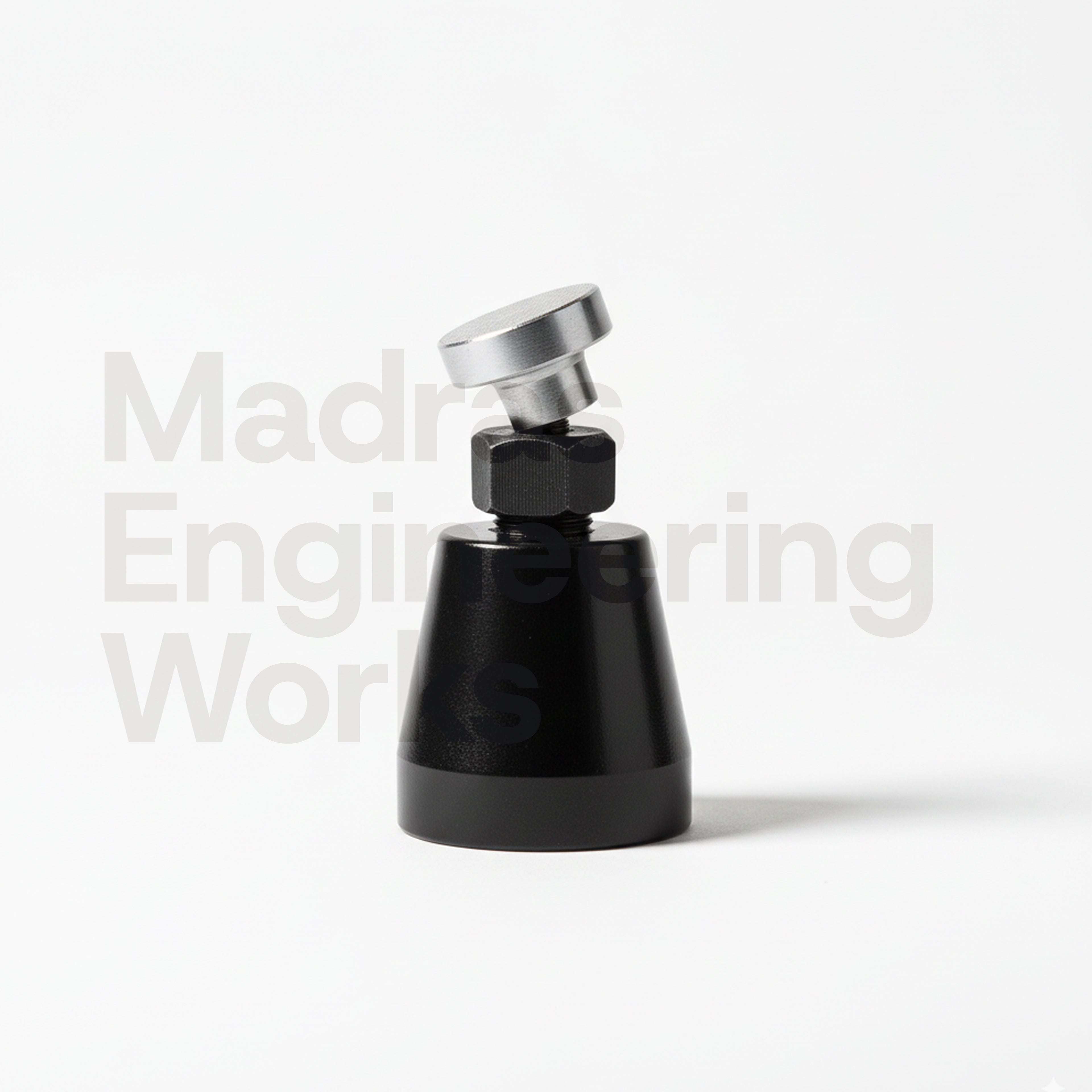
- Workpiece is vibrating at unsupported sections: Add a machining screw jack under the unsupported overhang. The clamps may be correct; the chatter source is elsewhere.
- High-volume, fast changeover: A Quick Clamp or Lever Clamp reduces each loading cycle to a single action.
The Shortcut: Universal Clamping Kit
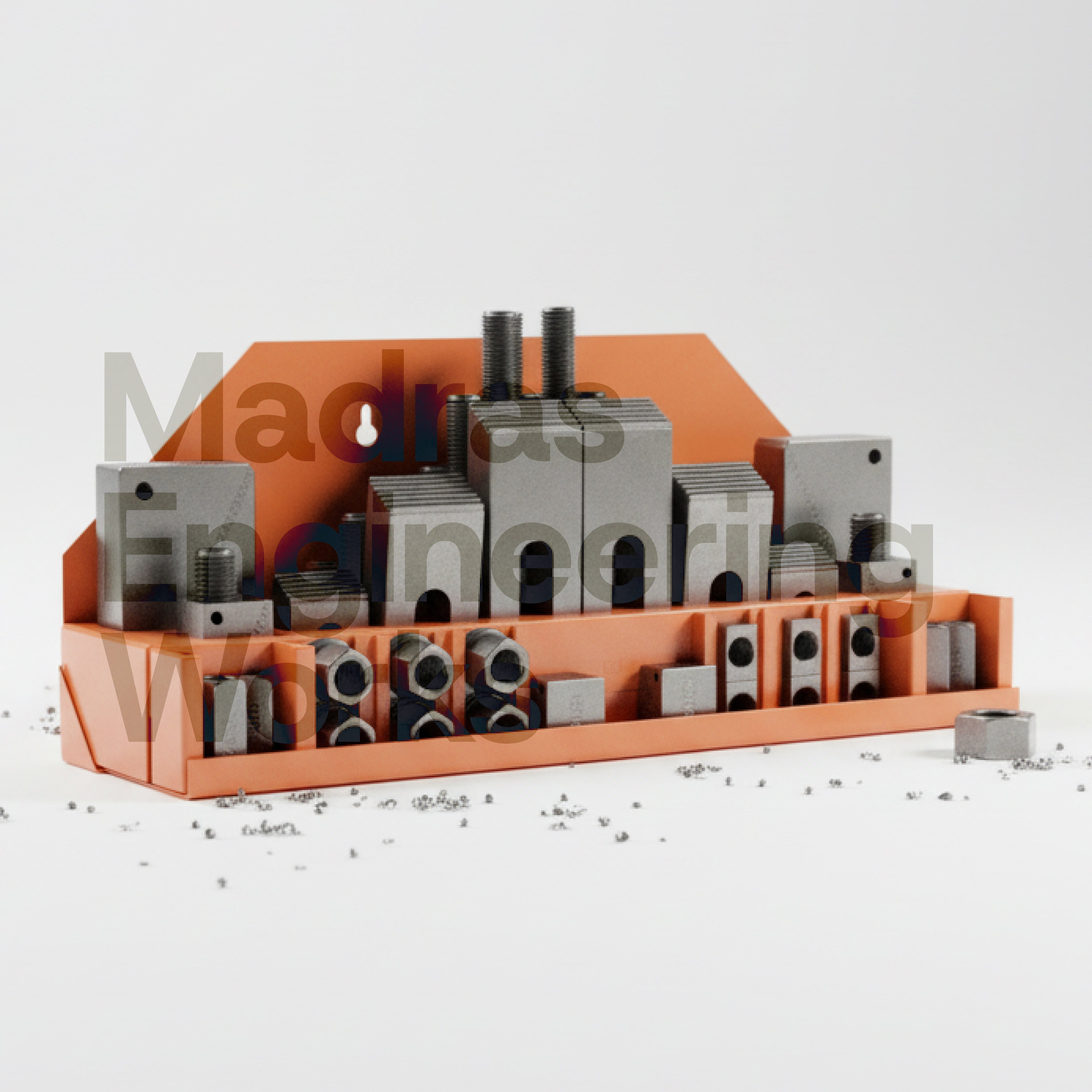
If you’re setting up a new VMC or tool room, a Universal Clamping Kit contains a pre-matched set of T-bolts, step blocks, strap clamps, studs, nuts, and washers sized for your machine’s T-slot. Everything is compatible, nothing needs sourcing separately. Available for 12 mm, 14 mm, and 16 mm T-slot tables on BFW, ACE, Jyoti, KENT, Lokesh, Haas, and all other standard VMC and milling machine brands.
Frequently Asked Questions
What is workholding in CNC machining?
Workholding is the system of components — T-bolts, T-slot nuts, clamping studs, step blocks, strap clamps, washers, and nuts — that secure a workpiece to the machine table during cutting. Every component in the stack must be correctly specified and installed for the system to hold the part rigid against cutting forces without shifting, lifting, or vibrating.
What T-slot size do I need for my VMC?
The three standard T-slot widths on Indian VMC and milling machine tables are 12 mm, 14 mm, and 16 mm. BFW, ACE, Jyoti, KENT, Lokesh, and Haas machines all use one of these. Measure the slot opening with a steel rule, or send a photo to +91 95143 73702 and we’ll confirm before you order.
Why is my clamp not holding the workpiece properly?
Check three things: (1) Is the step block too high? If the clamp angles upward at the workpiece end, effective downward force is reduced. (2) Is the T-bolt or T-nut the correct size for the slot? A loose fit means the stack rocks instead of holding rigid. (3) Is the clamping stud long enough? Insufficient thread engagement in the T-nut means the nut can strip under load. These three cover 90% of clamping failures.
What is the difference between a T-bolt and a clamping stud?
A T-bolt has a T-shaped head that slides directly into the machine table T-slot. A clamping stud is a threaded rod that screws into a T-slot nut sitting in the slot. Both anchor the clamping stack to the table. T-bolts are faster to position; clamping studs with T-slot nuts allow finer positioning and are common in dedicated fixture construction.
When should I use a downhold clamp instead of a strap clamp?
Use a downhold milling clamp when the machining operation requires the full top face of the workpiece to be accessible, when workpiece lift or chatter is occurring under heavy cuts, or when the workpiece geometry makes top clamping difficult. A downhold clamp applies force from the side — simultaneously downward and inward — with no strap crossing the top face. See the full downhold milling clamp guide.
Written by Husain, Founder of Madras Engineering Works — an ISO 9001:2015 certified industrial supplier in Chennai specialising in workholding, clamping and CNC accessories. Need help speccing the right workholding setup for your machine and operation? WhatsApp +91 95143 73702 or email enquiry@madrasengg.com.


0 comments