
Clamping Stud Types for Milling Fixtures: Which One for Your Application (India Guide)
Most Indian tool rooms stock one type of clamping stud for milling fixtures and use it for everything — standard milling, heavy cutting, press tool dies, injection mould platens. That works until it doesn't: a stud that yields under press loads, a T-nut bore that galls after a few hundred cycles, a stud that spins during installation and never fully seats. There are five clamping stud variants in MEW's catalogue, each with a specific design feature that exists for a specific reason. This guide explains what each one is, when to use it, and the failure mode you avoid by choosing correctly.
Note: this guide covers stud TYPE selection. For stud length selection, see the Clamping Stud Length Selection guide.
The Five Clamping Stud Types: At a Glance
| Stud Type | SKU | Grade / HRC | Key Design Feature | Primary Application |
|---|---|---|---|---|
| Standard Plain Stud | T2-CS-840 | 8.8 / IS 1367-2002 Pt III | None — plain double-ended thread | General VMC and milling workholding |
| Stud with Annular Ring | T2P-C9FR-12125 | 24–30 HRC | Ring shoulder seats on T-nut face | High-cycle die and mould clamping on tapped plates |
| Stud with Annular Ring + Spanner Flat | T2P-CSFR-12125 | 24–30 HRC | Ring + open-end spanner grip on shank | Die clamping where controlled installation torque is needed |
| Stud with Hex Drive | T2P-CSX-12125 | 24–30 HRC | Hex socket end for fast install/removal | Production VMC fixtures with frequent changeover |
| Heavy Duty Stud with Spanner — 10.9 | T2P-C9SF-10.9-12125 | 10.9 grade | Higher proof strength + spanner flat | Heavy milling, press tool, die and mould clamping |
Standard Clamping Stud (T2-CS-840): The General-Purpose Anchor
The standard clamping stud is a plain double-ended threaded bar — no head, no drive feature, no shoulder. The short threaded end engages the T-slot nut; the long threaded end carries the clamp, washer, and nut stack above.
MEW's standard stud is manufactured to 8.8 grade as per IS 1367:2002 (Part III). Hardened and tempered medium carbon steel, chemically blackened. Tensile strength approximately 800 MPa.
- Use for: Standard CNC and VMC milling workholding with strap clamps and step blocks
- Do NOT use for: Press tool die clamping (8.8 grade will yield under repeated press load cycles) or high-cycle tapped fixture plates (no shoulder to distribute seat load)
Clamping Stud with Annular Ring (T2P-C9FR-12125): High-Cycle Die and Mould Clamping
The annular ring changes the load path. The ring seats on the flat top face of the T-nut when correctly installed. Under clamping load, the axial reaction transfers into the T-nut face area rather than through the thread bore alone — distributing load across a much larger bearing area. The bore survives high-cycle press and moulding use without deformation.
The ring also provides a positive installation stop — consistent seating depth every time. 24–30 HRC. SKU T2P-C9FR-12125.
Clamping Stud with Annular Ring + Spanner Flat (T2P-CSFR-12125): Controlled Installation
This stud adds a spanner flat to the annular ring stud — a machined flat section on the shank that accepts an open-end spanner. Specified when both annular ring load distribution and controlled bottom-thread installation torque are required — typically precision die and mould applications where fixture plate tapped holes are expensive to replace.
Not sure which stud you need? WhatsApp +91 95143 73702 with your fixture plate or machine type.
Clamping Stud with Hex Drive (T2P-CSX-12125): Production Speed
The hex drive stud has an annular ring plus a hex socket end, allowing installation with a standard hex key or socket set. Faster in production VMC environments where fixtures are changed over frequently; compatible with any hex key set — no size-matching to jaw width required. SKU T2P-CSX-12125, 24–30 HRC.
Heavy Duty Clamping Stud with Spanner — Grade 10.9 (T2P-C9SF-10.9-12125)
Grade 10.9 delivers approximately 30% higher proof strength than grade 8.8 — around 1040 MPa versus 800 MPa. A grade 10.9 stud must be paired with a nut rated for 10.9 or higher. If a standard grade 8 nut is used at the stud's design torque, the nut threads will strip before the stud reaches its correct preload.
Use for: press tool die clamping, heavy VMC and HMC milling, injection mould clamping with extreme platen forces.
The Drive Feature Misuse Warning
The hex end and spanner flat are installation features only. A common mistake: using them to help the top nut run down faster by simultaneously turning the stud from below. This over-torques the stud into the plate, can gall the tapped hole, and — if the stud has an annular ring — lifts the ring off its face seat, removing the load distribution it was designed to provide.
Which Stud for Which Application
| Application | Correct Stud | SKU |
|---|---|---|
| Standard VMC / milling workholding | Standard Plain Stud | T2-CS-840 |
| High-cycle die/mould on tapped plate | Annular Ring Stud | T2P-C9FR-12125 |
| Die/mould, controlled bottom-thread installation | Annular Ring + Spanner Flat | T2P-CSFR-12125 |
| Production VMC, frequent changeover | Stud with Hex Drive | T2P-CSX-12125 |
| Press tools, heavy milling, extreme loads | Heavy Duty 10.9 + Spanner | T2P-C9SF-10.9-12125 |
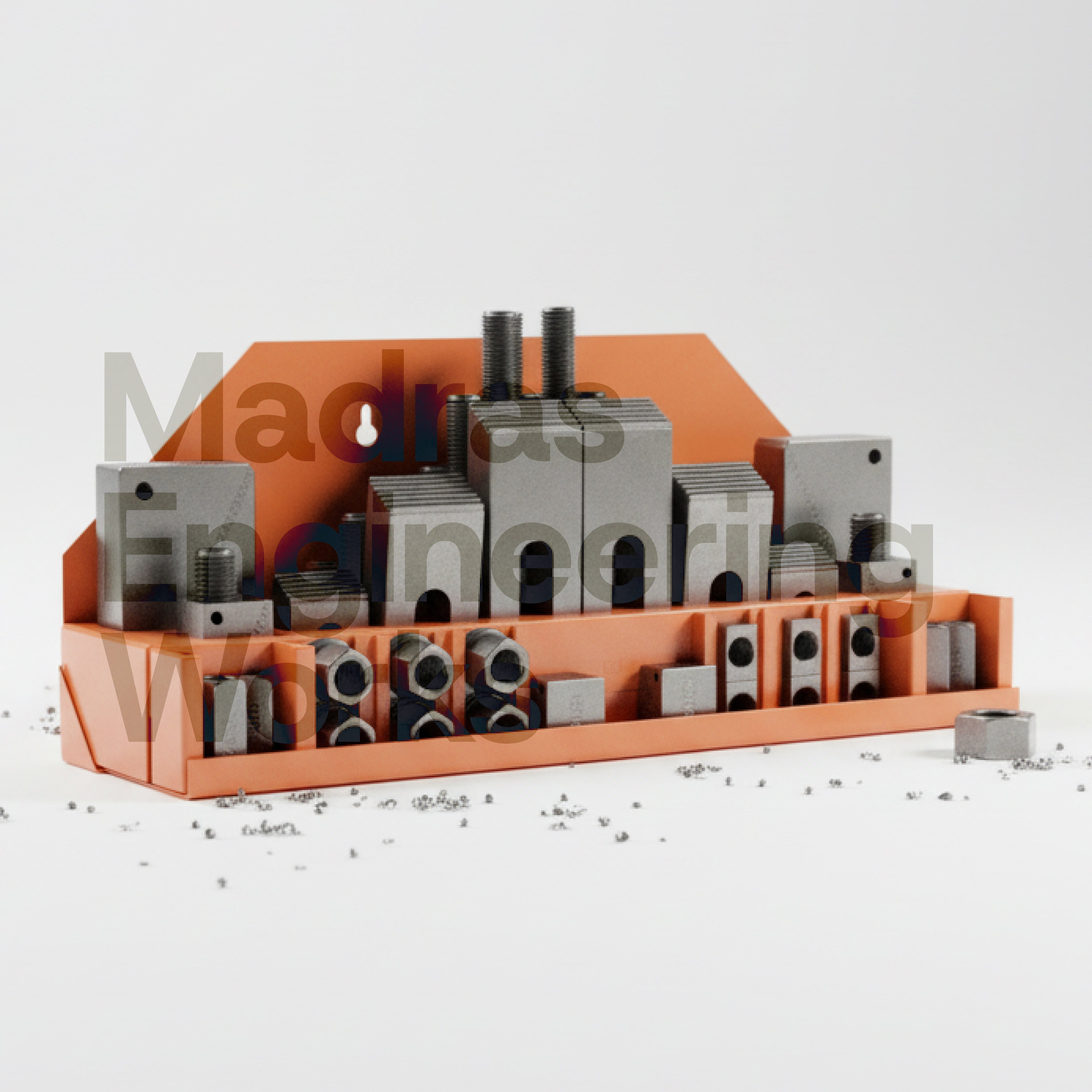
All studs fit T-slot nuts for 12mm, 14mm, and 16mm T-slot machine tables. See the Workholding Clamps for CNC India guide for the complete workholding stack.
Frequently Asked Questions
What is the purpose of the annular ring on a clamping stud?
The annular ring seats against the flat top face of the T-nut when installed. It transfers the axial clamping reaction into the bearing face rather than through the thread bore alone, distributing load over a larger area and preventing bore deformation under repeated high-force clamping cycles.
When should I use a grade 10.9 clamping stud instead of grade 8.8?
Use grade 10.9 for press tool die clamping, heavy milling of large steel components, and injection mould clamping. Always pair a 10.9 stud with a nut rated for 10.9 or higher — a standard grade 8 nut will strip before reaching the stud's design preload.
What is the difference between a spanner flat and a hex drive on a clamping stud?
Both are installation-only drive features. A spanner flat is gripped by an open-end spanner; a hex drive accepts a standard hex key. Neither should be used during clamping in service — for installation only.
Can I use one type of clamping stud for all my VMC workholding applications?
A standard 8.8 grade plain stud (T2-CS-840) is adequate for most general VMC milling. Where it is not adequate: press tool applications need 10.9; high-cycle tapped fixture plates need annular ring; production setups with frequent changeover benefit from hex drive.
What T-slot sizes do MEW clamping studs fit?
MEW's clamping studs fit T-slot nuts for 12mm, 14mm, and 16mm T-slot machine tables — the three standard widths on BFW, ACE, Jyoti, KENT, Lokesh, Haas, and other major VMC and HMC brands.
Written by Husain, Founder of Madras Engineering Works — ISO 9001:2015 certified industrial supplier in Chennai. WhatsApp +91 95143 73702 or email enquiry@madrasengg.com.

0 comments