
EDM Wirecut Clamping Kit India: Why Standard Clamps Fail & What to Use Instead
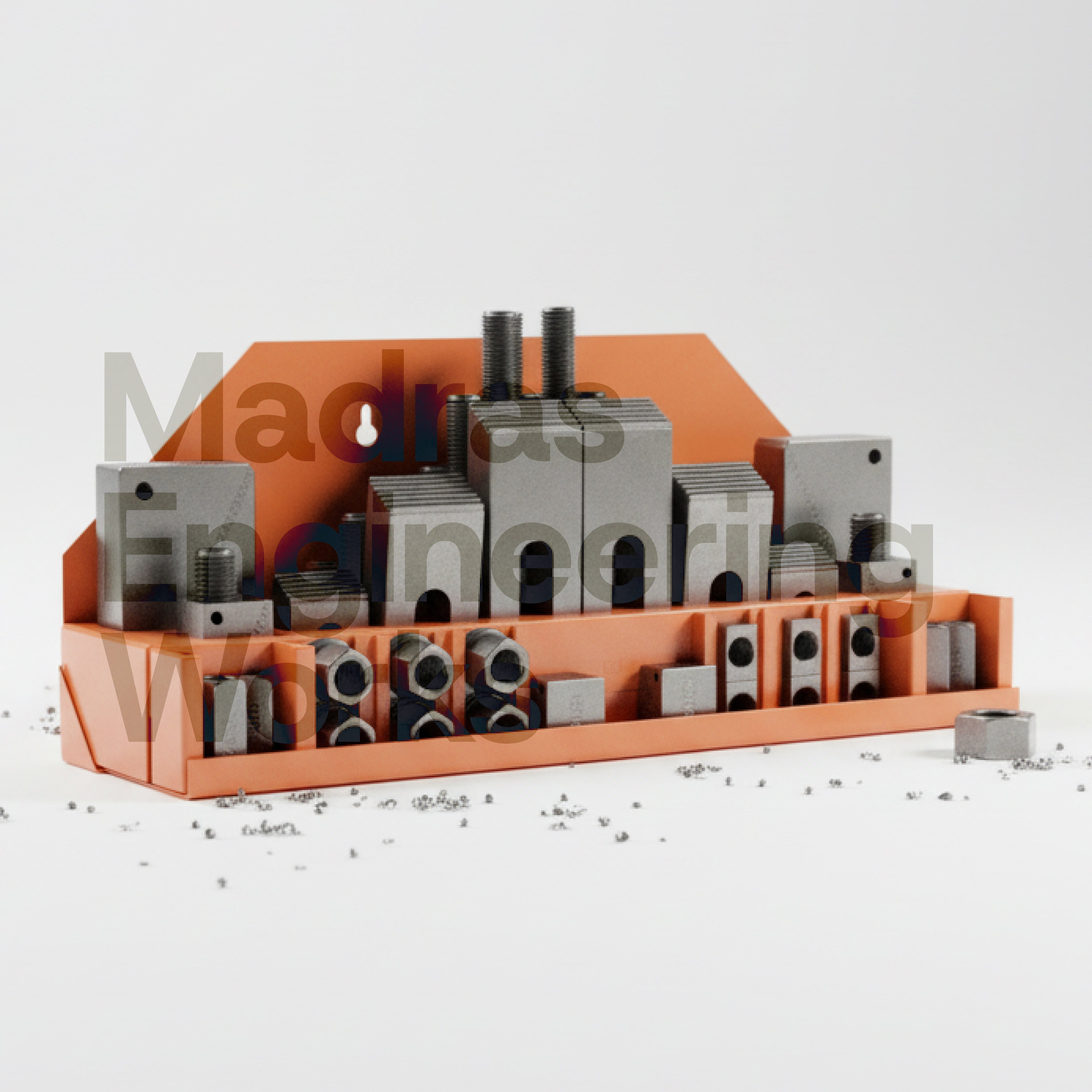
If your wire-cut EDM machine is running on standard milling clamps — T-bolts, T-nuts, and strap clamps pulled off the VMC shelf — you have a problem that hasn't shown up yet. In a dielectric tank, plain carbon steel workholding corrodes within weeks. T-nuts seize in the table slots. T-bolt threads gall. The entire setup locks up, and clearing seized fasteners from a precision EDM table is expensive. An EDM wirecut clamping kit uses materials and finishes rated for continuous dielectric exposure. MEW's T4-TCK-1412B kit is stocked in Chennai for ₹13,740, compatible with Fanuc, Mitsubishi, Sodick, AgieCharmilles, and JOEMARS wire EDM machines.
Why Wire EDM Workholding Is Different from Milling Workholding
The dielectric environment destroys standard carbon steel
Wire EDM cuts by electrical discharge between a moving brass wire and the workpiece, submerged in deionised water dielectric. Deionised water has a conductivity below approximately 20 μS/cm — it is a powerful corrosive medium for unprotected carbon steel. Standard milling clamps are medium carbon steel with chemical blackening. That finish lasts weeks, not years, in a dielectric tank before it begins flaking and the substrate corrodes.
Once corrosion reaches the thread of a T-nut seated in a precision EDM machine table slot, you are not just replacing the T-nut. You are potentially dealing with a seized, galled table slot — a precision component that costs far more to repair than the kit would have. The widely cited rule in EDM workholding is simple: never use cast iron or unprotected carbon steel in an EDM dielectric tank. Source: CTE Magazine — Choosing Wire EDM Workholders.
EDM workholding is about positional accuracy, not clamping force
In milling, the clamp fights the cutting force. In wire EDM, there is no cutting force — the wire removes material by spark erosion without physically contacting the workpiece. What the workpiece must do is sit perfectly square and perpendicular to the machine table.
If the workpiece is clamped with a 0.01mm angular tilt, the wire cuts a taper of 0.01mm across the full cut height. For a 50mm thick die punch, that is a 0.01mm taper from top to bottom. On a punch-and-die set with a 0.02mm clearance, that taper produces interference on one face and over-clearance on the other. The part is scrap. The clamp was tight. The problem was angle, not force.
MEW EDM Wirecut Clamping Kit: T4-TCK-1412B
- SKU: T4-TCK-1412B
- Price: ₹13,740
- T-slot size: [VERIFY with Husain — confirm EDM table T-slot width(s) this kit fits]
- Piece count: [VERIFY with Husain — confirm exact number of components in kit]
- Components: [VERIFY with Husain — confirm component types]
- Material/finish: [VERIFY with Husain — confirm dielectric-rated material/finish]
- Compatible machines: Fanuc, Mitsubishi, Sodick, AgieCharmilles, JOEMARS wire-cut EDM machines
Uncertain about T-slot size or machine compatibility? WhatsApp +91 95143 73702 with your machine make and model and we'll confirm fitment before you order.
Machine Compatibility: Wire EDM Brands in India
- Fanuc (Robocut series) — widely used in Indian automotive die shops and precision tool rooms
- Mitsubishi (MV, MX series) — common in automotive Tier 1 and mould shops across Chennai, Pune, NCR
- Sodick (AQ, VL series) — precision wire EDM used in aerospace and medical device tool rooms
- AgieCharmilles (CUT series) — high-precision machines in aerospace and precision die applications
- JOEMARS — widely installed in Indian small-to-medium tool rooms for cost-effective wire cutting
What Happens When You Use Standard Milling Clamps on a Wire EDM
The progression is predictable:
- Weeks 1–4: Everything appears to work. Chemical blackening is intact.
- Weeks 4–8: Blackening begins flaking in the dielectric tank. Surface rust appears on T-bolt and T-nut threads.
- Months 2–3: T-nut threads corrode. T-bolt threads begin galling. Positional repeatability drops.
- Months 3–6: T-nuts seize in the machine table slots. Removing them without damaging the precision-ground slot requires careful tooling and time.
The cost of a seized table slot repair dwarfs the ₹13,740 cost of the correct kit. The correct kit, maintained properly, lasts for years in dielectric service.
Clamping Technique for Wire EDM: The Accuracy Rules
Always check perpendicularity before cutting
After clamping the workpiece, use a dial indicator or precision square to verify the reference face is perpendicular to the machine table within your required tolerance. For punch-and-die work to tight clearances, this check is not optional.
Don't over-tighten
Over-tightening distorts thin plates and bends the workpiece slightly. The bend is set by the clamp; the cut follows the bent workpiece; when the clamp comes off, the part springs back and the cut profile is no longer true.
Keep the cut path clear of clamp bodies
The wire path must remain clear of all clamping components throughout the cut. Plan clamp positions before programming. A clamp in the path means a wire break, a scrapped setup, and lost machine time.
Separate EDM and milling clamps completely
Once EDM-rated components have been in dielectric, keep them separate from the general workholding stock. Label the EDM kit and its storage location clearly.
EDM Kit vs VMC Clamping Kit: What's Different
| Factor | VMC / Milling Clamping Kit | EDM Wirecut Clamping Kit |
|---|---|---|
| Environment | Air / coolant mist | Deionised water dielectric (submerged) |
| Primary failure mode | Insufficient clamping force → workpiece lift | Corrosion of carbon steel → seized fasteners |
| Key accuracy requirement | Resist cutting force | Maintain perpendicularity and flatness |
| MEW kit SKU | T4-TCK-108 (₹7,510) | T4-TCK-1412B (₹13,740) |
For a full comparison of all five clamping kit types, see the CNC Machine Clamping Kit India guide. For the VMC workholding stack, see the Workholding Clamps for CNC India guide.
Frequently Asked Questions
Can I use standard milling clamps on a wire-cut EDM machine?
No. Standard milling clamps are medium carbon steel with chemical blackening — a finish that lasts weeks in EDM dielectric (deionised water). Once the blackening flakes, carbon steel corrodes rapidly. Corroded T-nut and T-bolt threads seize in precision EDM table slots. Use only dielectric-rated clamping components on wire EDM machines.
What machines is the MEW EDM clamping kit compatible with?
MEW's T4-TCK-1412B is compatible with wire-cut EDM machines from Fanuc, Mitsubishi, Sodick, AgieCharmilles, and JOEMARS. For other brands, WhatsApp your machine model to +91 95143 73702 for a compatibility check before ordering.
What is the price of an EDM wirecut clamping kit in India?
MEW's T4-TCK-1412B EDM wirecut clamping kit is ₹13,740 ex-Chennai. This compares to ₹40,000+ for equivalent EROWA or System 3R compatible components imported into India. MEW's kit is an India-made, ISO 9001:2015 certified solution at a significantly lower price.
Why does EDM workholding require positional accuracy rather than clamping force?
Wire EDM is non-contact — the wire removes material by electrical discharge without physically pushing the workpiece. There is no cutting force to resist. The workpiece must instead be positioned perpendicularly to the table, because any angular deviation produces an equivalent taper in the cut profile. For tight-clearance die and punch work, that taper is a scrap part.
How should I store and maintain an EDM clamping kit?
Keep EDM-rated components separate from standard milling workholding. Store dry when not in use. Do not mix dielectric-exposed components with fresh milling clamps. Inspect threads before each setup. Replace any component showing galling or surface deterioration before a precision cut.
Written by Husain, Founder of Madras Engineering Works — ISO 9001:2015 certified industrial supplier in Chennai. WhatsApp +91 95143 73702 or email enquiry@madrasengg.com.

0 comments