

In CNC machining, a slipping workpiece is more than an inconvenience — it’s a direct hit on productivity, accuracy, tool life, and operator safety. Many Indian workshops lose hours of machining time every week due to improper clamping, worn fixtures, or incorrect force.
The good news? Most slippage issues come from 7 predictable mistakes, and each one can be solved with simple improvements.
Before we begin, you can explore MEW’s high-quality clamping solutions here:
👉 Clamping Elements
Why Does Workpiece Slippage Happen?
Slippage occurs when the clamp fails to create enough friction or holding force to resist machining loads.
This results in:
-
Dimensional inaccuracy
-
Vibration/chatter
-
Damage to the cutter
-
Scrap components
-
Unsafe working conditions
Most slippage cases in Indian shops are caused by clamping technique, not the machine.
1. Incorrect Clamping Force (Most Common Mistake)
🔧 Under-Clamping (Not Enough Pressure)
Happens when operators tighten by feel — or are afraid of marking the part.
Results in:
-
Micro-movement
-
Cutter chatter
-
Inconsistent finish
-
Tool breakage
Fix: Use torque wrenches or pre-calibrated tightening routines.
Use stronger, reliable clamping elements:
👉 T-Bolt / Stud Set
👉 Strap Clamp
🔧 Over-Clamping (Too Much Pressure)
Common when machining thin plates or soft metals.
Results in:
-
Workpiece bending
-
Loss of flatness
-
Inaccurate profiles
Fix:
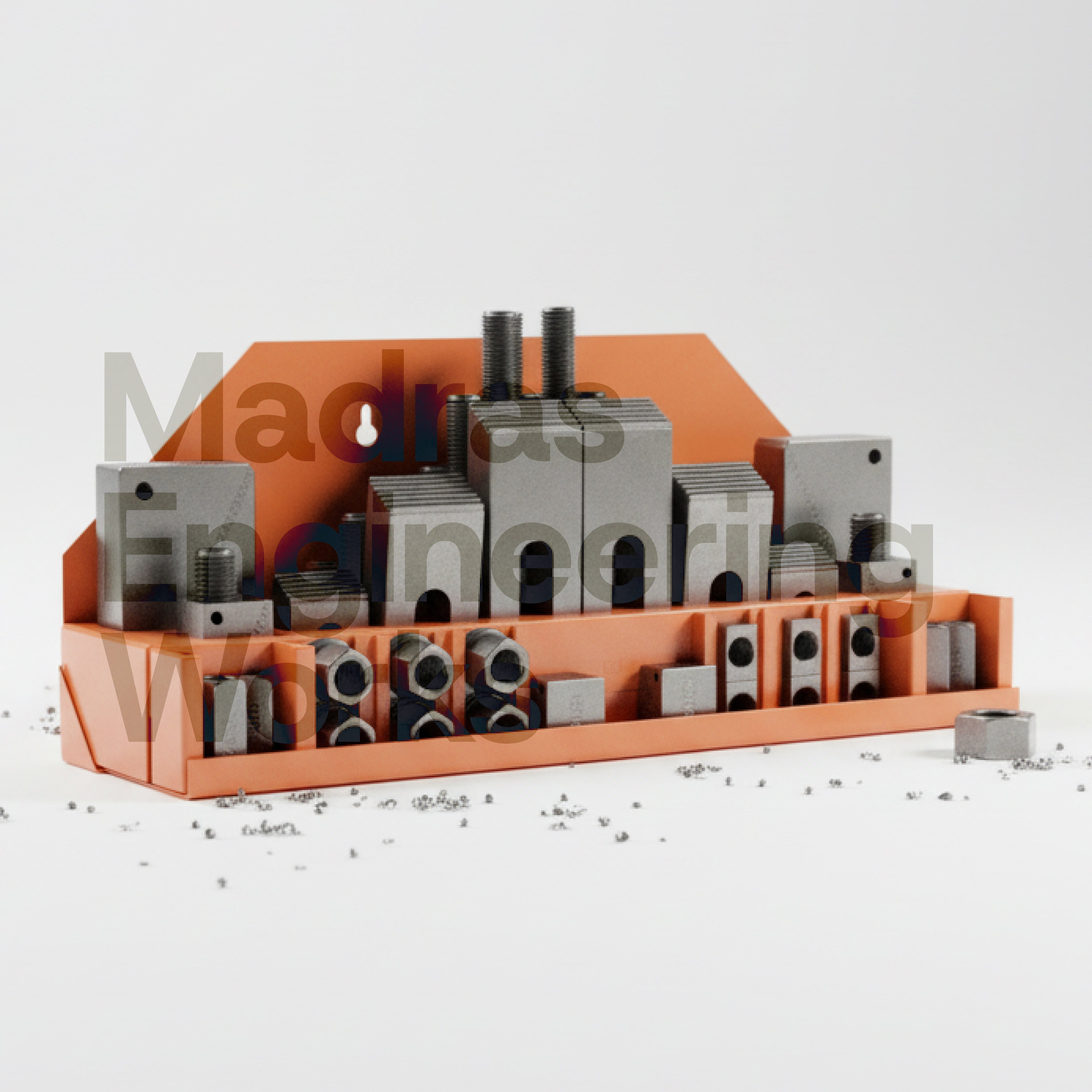
Use step blocks + strap clamps for even force distribution:
👉 Step Block Set
🔧 Uneven Force Distribution
If only one clamp is doing most of the work → slippage guaranteed.
Fix:
Use multiple strap clamps + a proper fixture layout.
2. Wrong Clamp Type for the Job
Most slippage comes from using:
-
A vise for an irregular shape
-
A strap clamp for a round workpiece
-
A magnetic clamp for thin ferrous sheets
-
A standard clamp for soft plastics
Correct Matching:
-
Flat parts → Strap clamps
👉 Flat Strap Clamp -
Tall parts → Step blocks
👉 Step Block Set -
Irregular shapes → Modular / combination clamps
-
Thin sheets → Vacuum pads
-
Ferrous plates → Magnetic clamps
3. Poor Fixture Stability (Especially in MSMEs)
A clamp is only as strong as the surface underneath it.
Common problems:
-
Worn step blocks
-
Bent T-bolts
-
Old vises with uneven jaws
-
Damaged T-slot tables
These reduce the holding power drastically.
Fix:
Replace worn studs, nuts, T-bolts:
👉 Stud + Nut Set
4. Material-Related Issues
Polished or Slippery Surfaces
Even with correct force → no grip.
Fix:
Lightly roughen the surface or degrease before clamping.
Soft Metals & Plastics
Excessive pressure = deformation.
Fix:
Use soft jaws, pads, or aluminum shims.
Oil and Coolant Residue
Surfaces covered in oil reduce friction.
Fix:
Clean before clamping.
5. Operator Errors (Most Underestimated Issue)
Improper Seating
Part not placed flat → clamp bites unevenly → slippage.
Improper Clamp Positioning
Clamp placed too far from the cutting zone reduces holding force.
Inconsistent Tightening Technique
Different operators = different results.
Wrong Clamp Selection
Trying to clamp everything using:
-
One vise
-
One set of strap clamps
-
One block clamp
Fix:
Train operators on basic clamping geometry and load paths.
6. Tooling & Vibration Issues
Even perfect clamping fails under:
-
Long tool overhang
-
Worn-out tools
-
Aggressive feed rates
-
Incorrect spindle speeds
-
Poor damping on the machine table
These are common in:
-
Job shops
-
MSMEs
-
Older CNCs and VMCs
Fix:
Minimize overhang, optimize feed/speed, increase support under the part.
7. Lack of Fixture Maintenance
Worn-out clamps = unpredictable gripping.
Most Indian shops overlook:
-
Dirty jaws
-
Rusted studs
-
Bent T-bolts
-
Damaged washer seats
-
Worn threads
Fix:
Use high-quality, hardened clamping hardware:
👉 T-Bolt
👉 U-Clamp
Real Examples From Indian Shop Floors
Here are real cases observed in Indian machining shops:
Automotive Job Shops
Operators under-clamp to avoid marking components → job slips during milling.
MSME Sheet-Metal Machining
Strong clamping bends thin plates → chatter → out-of-tolerance parts.
Die/Mould Shops
Reusing worn block clamps leads to inconsistent clamping.
Welding Units Using Improvised Clamps
Welding clamps used on milling tables → poor grip → local slip, especially on oily plates.
How to Prevent All Slippage Problems (Checklist)
✔ Use the right clamp for the right job
✔ Spread the load evenly
Use step blocks + strap clamps
👉 Step Block Set
✔ Clean the surfaces before clamping
Degrease workpiece + clamps
✔ Minimize tool overhang
Prevents force buildup & vibration
✔ Use stoppers / backrests
Prevents lateral movement


0 comments