

If a part lifts, chatters, or shifts during a heavy cut, most operators blame the machine or the feed. Usually it's the clamp. A standard strap clamp pushes at an angle, and under load that angle becomes lift. A downhold milling clamp solves this by pulling the workpiece down and in at the same time — so it stays flat on the table while you take the cut. This guide explains how it works, when to use it instead of a strap clamp, the T-slot sizes and machines it fits, and how to order the right set.
What a downhold milling clamp actually does
A downhold clamp applies clamping force in two directions at once: downward onto the table and inward against the workpiece. That combined force seats the part against the table surface instead of trying to pivot it.
Compare that to a conventional strap clamp. The strap pivots on a step block at one end and presses the workpiece at the other. The resulting force vector is angled — part of it holds the part down, but part of it pushes outward. During light cuts you never notice. During a heavy roughing pass in steel or cast iron, that outward component is enough to let the part lift a few microns, and that's all it takes for chatter, a bad finish, or a shifted datum.
Why workpiece lift is the real problem (not your machine)
We get this on WhatsApp constantly: "the part moved mid-cut, is the VMC worn out?" Almost never. The sequence is usually this:
- Strap clamp set at an angle, or the step block one notch too low.
- Heavy cut starts; cutting force plus the clamp's outward vector lifts the leading edge.
- Part chatters — poor surface finish, sometimes a cracked insert or snapped end mill.
- Worst case, the part shifts off its datum and the whole job is scrap.
A downhold clamp removes the outward vector. The force goes straight down, so there's nothing to lift the part. You get a more rigid setup, better finish, and longer tool life on exactly the cuts where it matters.
Not sure whether your job needs a downhold clamp or a strap-and-step-block setup? WhatsApp us a photo of your part and table at +91 95143 73702 and we'll tell you straight.
Downhold clamp vs strap clamp: when to use which
- Use a downhold clamp for heavy roughing, interrupted cuts, tall/awkward parts, and anywhere lift or chatter has scrapped work before. It also keeps the top face clear so the cutter has full access.
- A strap clamp + step block is fine for light cuts, finishing passes, and quick low-force setups — it's cheaper and faster to reposition.
Most tool rooms keep both. The mistake is using strap clamps for everything and then fighting lift on the heavy jobs.
Specifications (MEW Downhold Milling Clamp, CES-DMC-1)
- Body & jaw seating: High-tensile S.G. iron for rigidity without brittleness.
- Jaw: Heat-treated steel, blackened for corrosion resistance.
- T-slot fit: 12 mm, 14 mm, and 16 mm slots.
- Application: Steel, cast iron and aluminium workpieces under heavy cutting.
- Use on: CNC vertical machining centres (VMC), HMC, milling machines, jig boring machines, fixture plates.
Will it fit your machine?
The MEW downhold clamp is built for standard Indian VMC/HMC tables. It fits machines from BFW, ACE, Jyoti, KENT, Lokesh and Haas, on the common 12 mm, 14 mm and 16 mm T-slot widths. The only thing you need to confirm is your T-slot width — measure the slot opening, or send us a photo and we'll confirm it.
The one ordering detail people miss
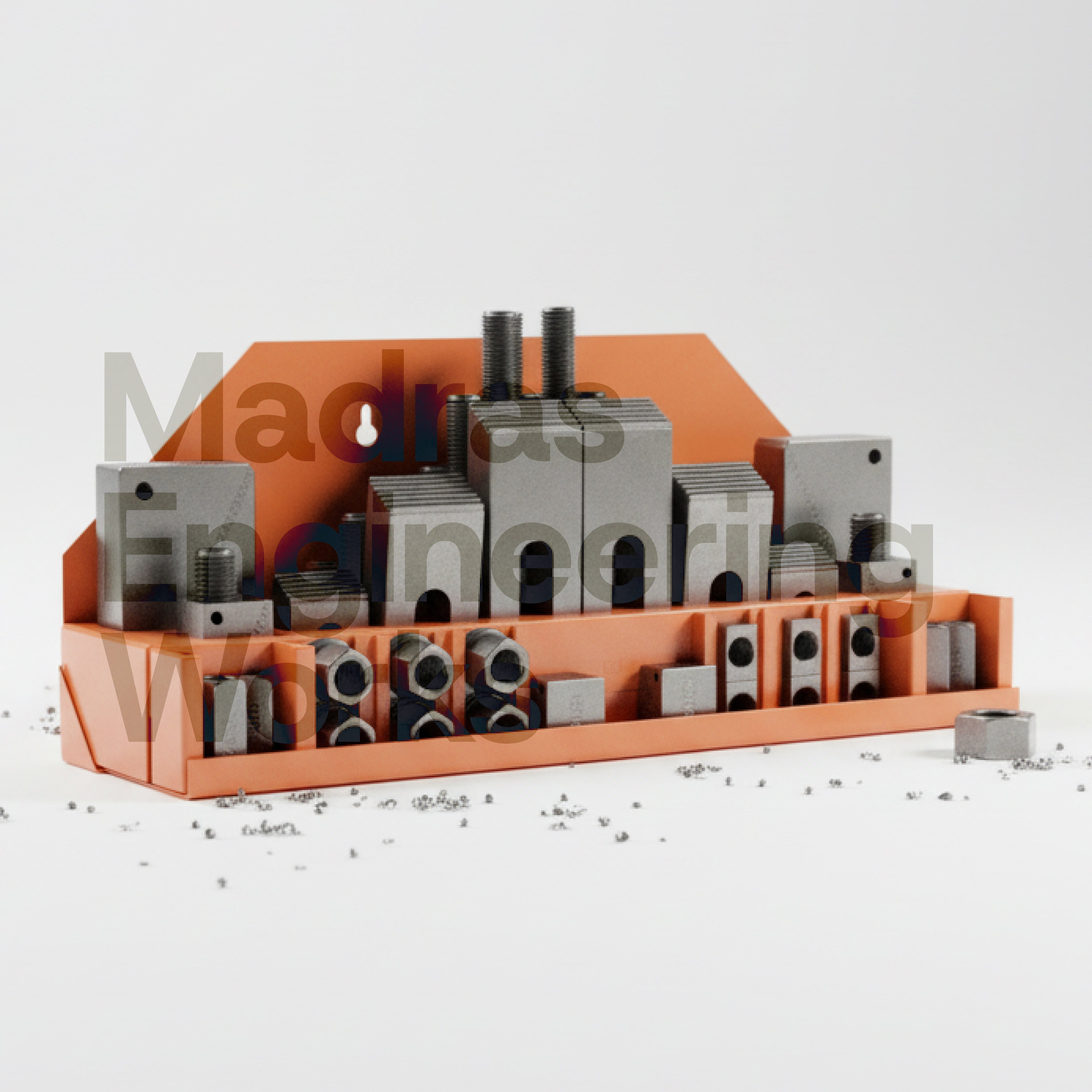
The downhold clamp is supplied without the T-bolt or stud. That trips up first-time buyers. You need a matching hold-down set for your slot size: a T-bolt, a hex hi-nut, and a thick plain washer. We supply that as an optional matched set so you don't end up with a clamp you can't actually bolt down. If you're unsure which set matches your slot, ask before you order — wrong-size hardware in a T-slot is how T-slots get damaged in the first place.
Frequently Asked Questions
What is a downhold milling clamp?
It's a workholding clamp that applies downward and inward force at the same time, seating the workpiece flat on the machine table. Unlike an angled strap clamp, it doesn't push the part outward, so it resists lift during heavy cuts.
What's the difference between a downhold clamp and a strap clamp?
A strap clamp applies force at an angle and can let a part lift under heavy load. A downhold clamp applies force straight down, eliminating lift and reducing vibration. Use the downhold clamp for heavy cuts; the strap clamp is fine for lighter work.
What T-slot sizes does it fit?
The MEW downhold clamp fits 12 mm, 14 mm and 16 mm T-slots, covering most Indian VMC and HMC tables including BFW, ACE, Jyoti, KENT, Lokesh and Haas.
Does it come with the T-bolt?
No — it's supplied without the T-bolt or stud. A matching set (T-bolt, hex hi-nut, thick plain washer) for your slot size is available as an option. Order the matched set so the hardware fits your slot correctly.
Why does my workpiece lift during milling?
Usually because an angled clamp's outward force component, combined with cutting force, lifts the leading edge. Switching to a downhold clamp removes that outward force and stops the lift.
Written by Husain, Co-Founder of Madras Engineering Works — an ISO 9001:2015 certified supplier of CNC workholding, clamps, T-bolts, T-nuts and clamping kits in Chennai, India. Need the right clamp and matching hardware for your machine? WhatsApp +91 95143 73702 or email enquiry@madrasengg.com with your T-slot size and we'll spec it for you.

1 comment
Very informative!