

If a workpiece chatters on your VMC and the clamps look correct, the problem is almost always the same: there is an unsupported section beyond the last clamp point. A screw jack for milling machine work provides the adjustable rigid support that stops overhang vibration, levels irregular datum surfaces on castings and forgings, and keeps precision batch setups repeatable. This guide covers how machining screw jacks work, which head type to choose, when to lock, and the complete MEW range.
What a Machining Screw Jack Does
A screw jack is an adjustable-height support element. The spindle threads in or out to reach the exact height of the workpiece underside, the head contacts the surface, and the jack provides a rigid support point that a fixed parallel or block cannot — because fixed supports cannot adapt to part geometry or setup height.
Three distinct applications:
- Overhang support: A clamped workpiece extending beyond the last clamp vibrates at the unsupported end under cutting forces. One jack under the overhang eliminates that vibration — chatter stops, surface finish improves, tool life extends. For setups where the clamp itself blocks the machined surface, a downhold milling clamp keeps the top face clear while still holding the part — a different problem, a different tool.
- Irregular datum levelling: Castings, forgings, and weldments rarely have perfectly flat datum surfaces. Three jacks under the part create stable, adjustable three-point contact that conventional parallels cannot replicate on non-flat surfaces.
- Inspection support: On surface plates and CMM tables, jacks provide stable, vibration-free support during layout and dimensional measurement, preventing the rocking that introduces measurement error.
The Diagnostic That Tells You a Screw Jack Is Missing
Before adjusting feeds, speeds, or changing inserts, run this test: with the spindle off and the part clamped, press down firmly on every unsupported section. If any area flexes or moves under hand pressure, it needs a jack. That flex is the chatter source — the cutter deflects the section, springback follows, deflect again. Surface finish fails. Inserts wear faster than they should. The cause is the setup, not the machine.
This test takes thirty seconds and identifies the real problem without guesswork.
Still getting chatter after supporting all unsupported sections? WhatsApp us a photo of the part and setup at +91 95143 73702 and we’ll help diagnose the remaining cause.
Thread Types: Why Trapezoidal vs Vee Rolled Matters
Most machining screw jacks use trapezoidal threads. This is not arbitrary:
- Trapezoidal threads have a wide, flat contact face between thread flanks. This generates high friction under load, making the spindle self-retaining — it will not rotate backwards under machining vibration. The Bureau of Indian Standards (IS 7008) covers trapezoidal thread dimensions; the design principle is consistent with the global standard.
- Vee rolled threads (MEW’s quality layout jack, CES-QSJ-50) give finer, more precise height adjustment — correct for inspection and CMM work where positioning matters more than vibration resistance. The thread form is not self-retaining under sustained vibration. Use vee thread jacks only in inspection and layout setups — never in a live machining environment.
Head Types — Which Configuration to Use
Flat Head — Standard (CES-SBSJ-40)
Flat contact face for flat or near-flat datum surfaces. Trapezoidal threads. The right starting point for general overhang support on prismatic workpieces. Start here unless you have a specific reason to use another head type.
Swivel Head (CES-STSB-45)
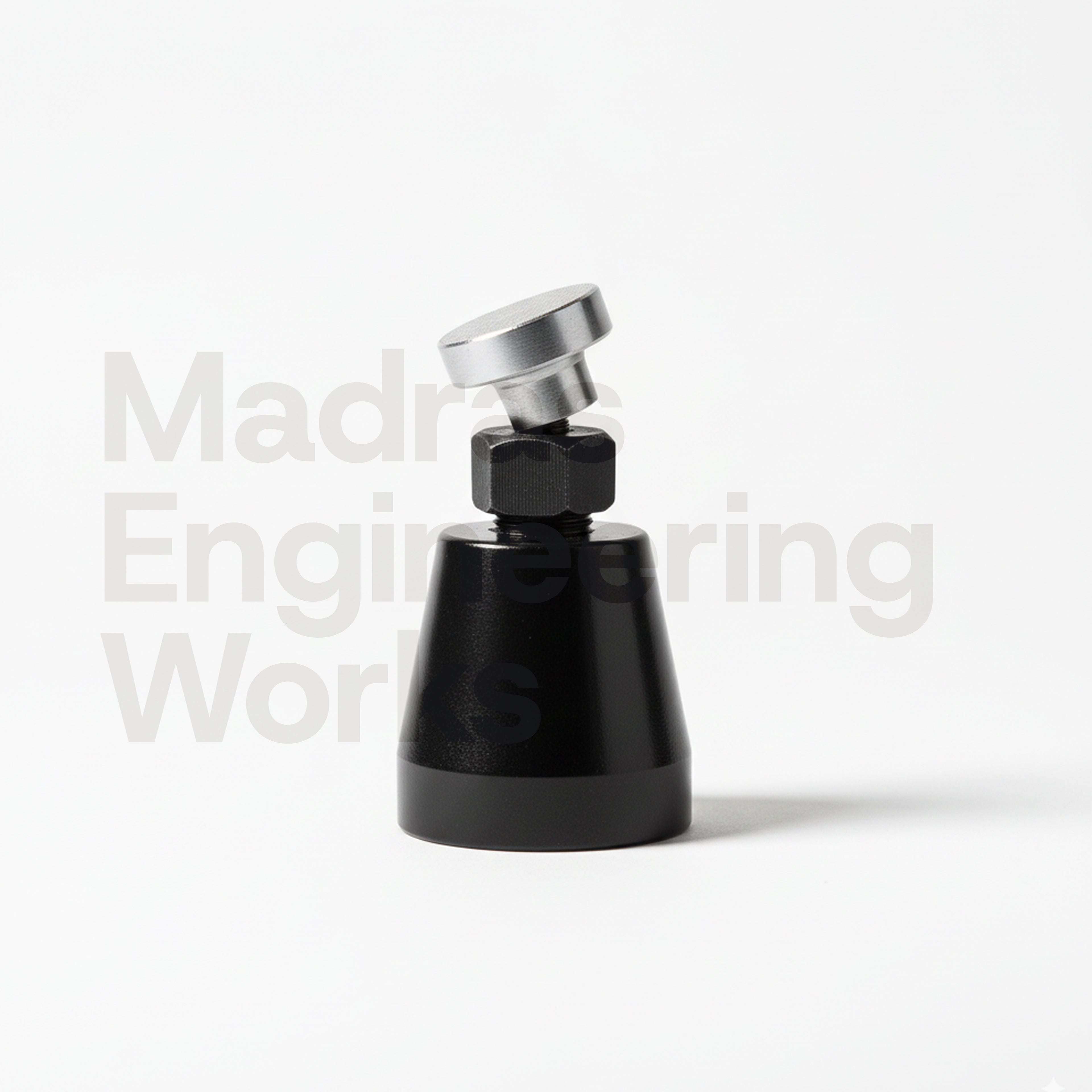
The ball-and-socket swivel head self-aligns to any surface angle. Diamond serrations on the swivel face grip once aligned, preventing lateral slip. Use for castings, forgings, and weldments where the support surface is not parallel to the machine table. A flat-head jack on an angled surface contacts at a point and can slip laterally under cutting force — the swivel head eliminates this. MEW’s swivel jack includes a spindle stopper that prevents the spindle from walking fully out of the body during operation — a safety feature absent from many imported alternatives.
Conical Head (CES-CHSB-40)
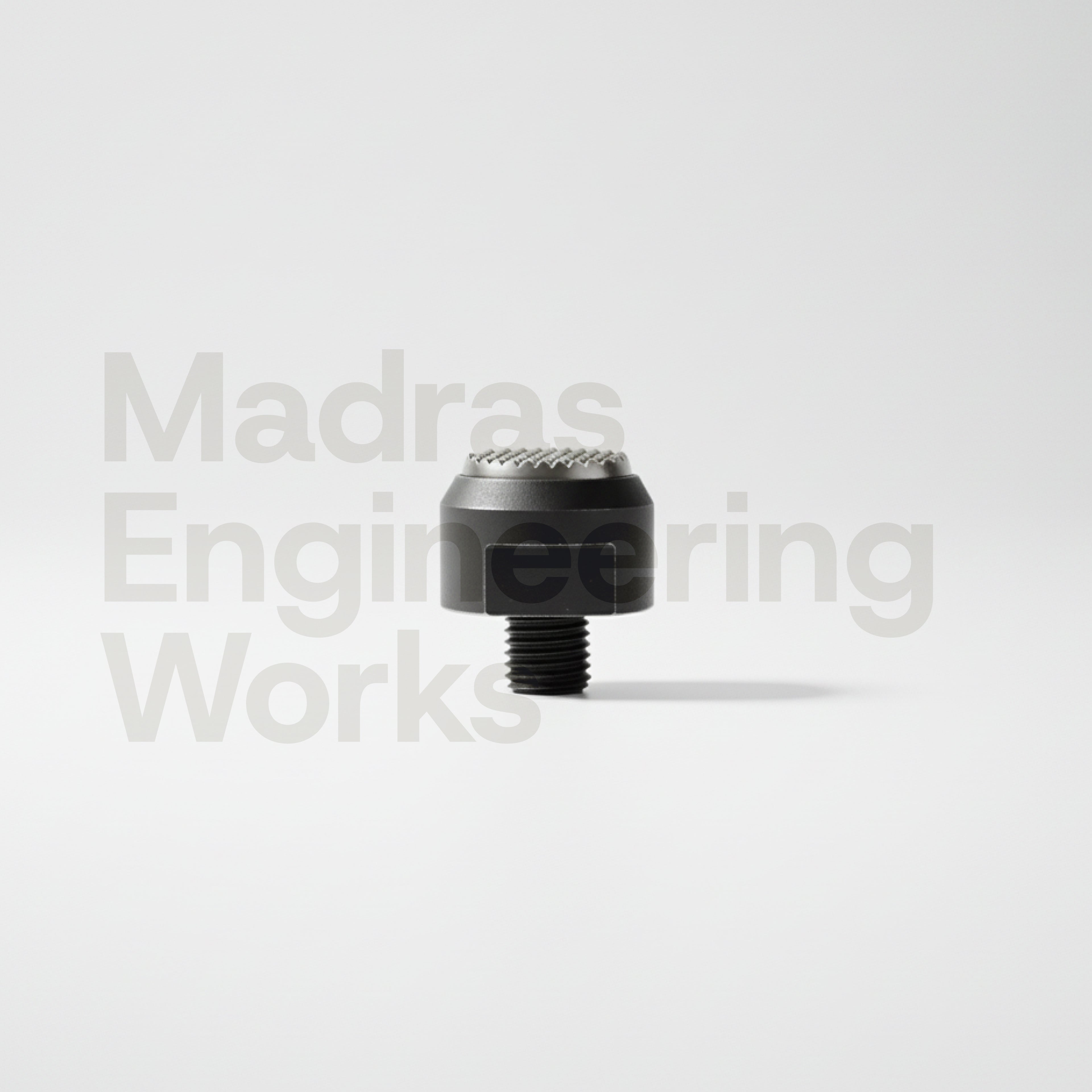
The conical point seats into a pre-drilled centre hole or recess on the workpiece underside. Positive lateral location: unlike a flat or swivel head that can be pushed sideways under cutting force, the conical head cannot shift once seated. Use for shafts, turned components, and precision parts that have a machined centre on the support face.
Conical Head + Lock Nut (CES-SCL-65)
Combines positive lateral location (conical head) with positive height locking (lock nut). Addresses two failure modes — lateral slip and height drift — simultaneously. Correct for precision batch work on centre-located parts where the jack must hold exactly the same height part after part. Includes the spindle stopper.
Quality Layout Jack (CES-QSJ-50)
Vee rolled threads for fine, precise height adjustment. Use on surface plates, CMM tables, and inspection setups. Not for live machining.
When to Add a Lock Nut — and When Plain Is Enough
Trapezoidal threads are self-retaining under normal machining vibration. A plain jack is sufficient for most setups. Add a lock nut when running a batch of identical parts (height must be identical every cycle), under heavy sustained cutting loads, or when the jack is a permanent fixture component that must not drift between production runs.
For fixture-mounted jacks, add a flange. Single-side flange (CES-50SF-100) when space around the jack is tight. Double-side flange (CES-50DF-200) for maximum bolting stability under heavy loads. The same T-bolt sizing principles that govern strap clamp setups apply when bolting flanged jacks to fixture plates — see our T-bolt selection guide for the correct hardware pairing. Broad-base (CES-BBLN-160) when a standard footprint would tip under heavy workpiece weight or sustained lateral cutting force.
Full MEW Screw Jack Range — Specs and Pricing
| SKU | Type | Thread | Use When |
|---|---|---|---|
| CES-CHSB-40 | Conical Head | Trapezoidal | Parts with machined centre holes — positive lateral location |
| CES-STSB-45 | Swivel Head | Trapezoidal | Castings, forgings — angled or irregular datum surfaces |
| CES-QSJ-50 | Quality Layout | Vee Rolled | Inspection and CMM setups only — no vibration |
| CES-SBSJ-40 | Standard Flat | Trapezoidal | General machining overhang support on flat surfaces |
| CES-SJLN-60 | Lock Nut | Trapezoidal | Batch machining — height must not drift between cycles |
| CES-SCL-65 | Conical + Lock Nut | Trapezoidal | Precision batch on centre-located parts — locates and locks |
| CES-50SF-100 | Single Flange + Lock Nut | Trapezoidal | Fixture-mounted, tight space |
| CES-BBLN-160 | Broad Base + Lock Nut | Trapezoidal | Heavy workpieces — wide footprint prevents tipping |
| CES-50DF-200 | Double Flange + Lock Nut | Trapezoidal | Fixture-mounted heavy load — double flange for max stability |
| CES-70DF-200 | Heavy Duty Double Flange + Brass Lock | Trapezoidal | Permanent fixture, frequent adjustment — brass preserves thread |
| CES-P-1 | Pads | — | Finished or soft surfaces — distributes load, prevents indentation |
Not sure which type suits your setup? WhatsApp +91 95143 73702 with your part size, material, and machine and we’ll specify the right jack type and quantity.
One Detail Worth Knowing: Why the Heavy-Duty Jack Uses Brass
The CES-70DF-200 uses a brass locking screw rather than a standard steel setscrew to lock the spindle. Steel setscrews embed into and deform the spindle thread surface after repeated tightening cycles. Once deformed, the spindle no longer adjusts smoothly. The brass screw locks firmly but leaves the thread surface undamaged — which matters when a production fixture is adjusted and re-locked daily. This detail is in MEW’s product specification. It does not appear in any IndiaMART listing for the same product category.
Frequently Asked Questions
What does a screw jack do in CNC machining?
A machining screw jack provides adjustable rigid support to a workpiece during cutting. It stops unsupported sections from vibrating under cutting forces, stabilises irregular datum surfaces on castings and forgings, and provides lockable, repeatable support in precision batch setups. Set the jack to contact the workpiece underside without lifting the part, lock if required, then machine.
What is the difference between a swivel head and a flat head machining screw jack?
A flat head jack contacts a flat, horizontal datum surface. A swivel head self-aligns to any surface angle via a ball-and-socket joint, giving full contact on angled or irregular surfaces rather than point contact. Use a swivel head for castings, forgings, or any part where the support surface is not flat or parallel to the machine table.
Why do machining screw jacks use trapezoidal threads?
Trapezoidal threads generate high friction under load, making the spindle self-retaining — it will not rotate backwards under machining vibration. A finer thread form would back off under sustained cutting vibration, causing the jack to lose contact mid-cut. MEW’s quality layout jack (CES-QSJ-50) uses vee rolled threads because it is designed for inspection work with no vibration, where fine positioning matters more than self-retention.
When do I need a lock nut on a screw jack?
A plain trapezoidal jack holds position under general machining. Add a lock nut when running a batch of identical parts (height must be identical every cycle), under heavy sustained cutting loads, or when the jack is a permanent fixture component. Flanged lock nut jacks (CES-50SF-100, CES-50DF-200) are correct when the jack bolts permanently to a fixture plate.
How many screw jacks do I need under a workpiece?
Three is the minimum for stable support on an irregular datum surface — three points define a plane and eliminate rocking. For overhang support on an otherwise clamped prismatic workpiece, one jack under the unsupported section is usually sufficient. For large or heavy workpieces, add jacks wherever pressing down by hand reveals flex.
Written by Husain, Founder of Madras Engineering Works — an ISO 9001:2015 certified industrial supplier in Chennai specialising in workholding, clamping and CNC accessories. Need help choosing the right screw jack for your machining setup? WhatsApp +91 95143 73702 or email enquiry@madrasengg.com.


0 comments