

In Chennai’s growing CNC ecosystem, accuracy is everything. Whether you're a small MSME in Guindy, a precision workshop in Ambattur, or a large manufacturer in Sriperumbudur, one truth never changes:
Your machining accuracy starts with your workholding.
At Madras Engineering Works — a leading manufacturer and retail supplier of clamping elements across all of Chennai — we see shop-floor problems every day that trace back to one root cause:
poor clamping and unstable work holding.
This guide explains why proper clamping dramatically improves CNC accuracy, surface finish, and tool life — especially in South Indian machining environments.
What Is Workholding?
Workholding refers to the devices and methods used to locate, position, and rigidly secure a workpiece during CNC machining.
This includes:
-
Vises
-
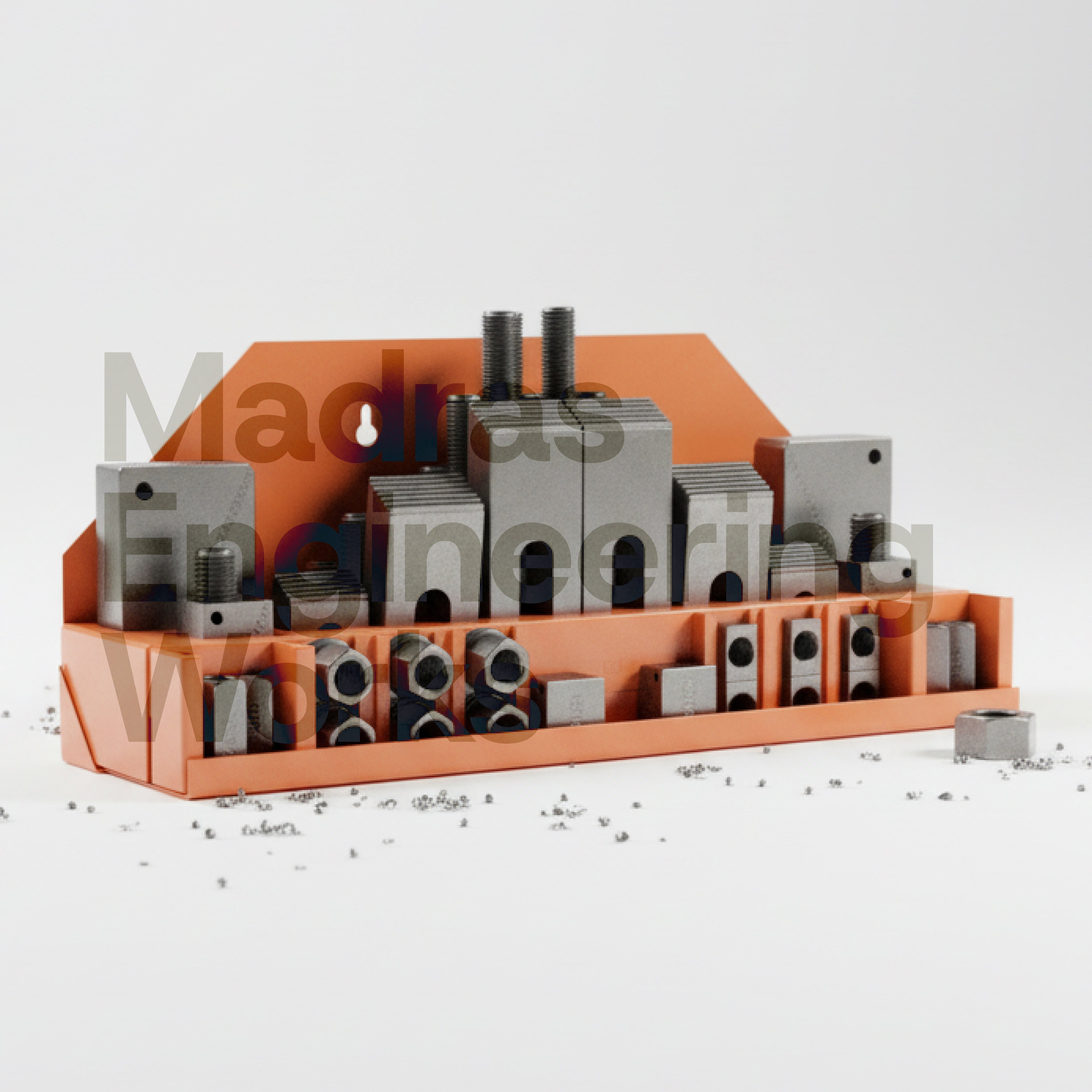
Strap clamps 👉 Flat Strap Clamp
-
Step blocks 👉 Step Block Set
-
T-bolts & studs 👉 T-Bolt / Stud Set
-
Modular fixtures
-
Magnetic & vacuum chucks
Good workholding eliminates unwanted movement and ensures the part stays stable throughout the machining cycle.
To understand the basics of clamping elements, you can read our foundational guide here:
👉 What Are Clamping Elements?
How Clamping Directly Affects Accuracy
✔ Prevents Micro-Movement
A securely clamped part stays rigid, maintaining tolerances even during heavy cuts.
✔ Eliminates Misalignment
Uneven pressure from poor clamping shifts the part mid-cut, resulting in out-of-spec parts.
✔ Distributes Force Evenly
Specialized clamps and fixtures spread force better than basic vises, preventing distortion on:
-
Thin plates
-
Aluminum parts
-
Electronics housings
-
Automotive castings
To understand clamp types, see our complete article:
👉 Types of CNC Clamps
How Clamping Affects Tool Life
Proper workholding reduces:
-
Tool chipping
-
Edge wear
-
Insert cracking
-
Excessive spindle load
-
Chatter-induced damage
With stable clamping:
-
Tools last longer
-
Surface finish improves
-
You can run higher feeds/speeds safely
When workpieces vibrate or slip, tools encounter inconsistent loads → premature failure.
For the most common slippage mistakes, read:
👉 How to Prevent Workpiece Slippage
Common Accuracy Failures Caused by Poor Clamping (Real Indian Cases)
1. Automotive Job Shops (Chennai & Coimbatore)
Loose fixturing or basic T-slot setups cause misaligned components and expensive rework.
2. MSME Fabrication Units
Thin sheets bend due to over-tightening strap clamps → chatter → poor surface finish.
3. Precision Toolrooms (Bangalore, Pune, Hosur)
Basic vises without alignment cause chatter marks in pump housings and critical parts.
4. Electronics Part Machining
Soft jaws not used → deformation on delicate plastic/aluminium parts.
These issues all connect to one core problem:
inconsistent, uncalibrated clamping setups.
How Vibration & Chatter Destroy Accuracy + Tool Life
Vibration happens when:
-
Clamp pressure is uneven
-
T-slot clamps are worn
-
Fixture base is not rigid
-
Tool overhang is excessive
-
Speeds/feeds exceed holding capacity
Chatter leads to:
-
Tool breakage
-
Rough finishes
-
Inaccurate dimensions
-
Heat buildup
Proper workholding absorbs vibration → cleaner, faster, safer machining.
Operator Mistakes That Reduce Accuracy
These are VERY common across South Indian CNC shops:
❌ Using the wrong clamp for the part geometry
Solution:
👉 Use modular clamps, step blocks & strap clamps properly.
❌ Dirty or worn clamp jaws / fixture plates
Dust or chips under the part = instant inaccuracy.
❌ Guessing clamp force
Tightening “by feel” is the #1 cause of deformation.
❌ Manual part alignment
Setting by eye instead of using:
-
Stops
-
Location pins
-
Probing systems
Fixture vs Manual Clamping (Which Gives Better Accuracy?)
| Attribute | Manual Clamping | Modular/Dedicated Fixtures |
|---|---|---|
| Repeatability | Low–Medium | High |
| Setup Time | Long | Fast |
| Force Control | Operator-based | Engineered & uniform |
| Best For | Simple parts | Complex / thin / production work |
| Total Cost | Cheap but error-prone | Long-term savings |
Workshops aiming for consistent accuracy move toward:
-
Modular fixtures
-
Zero-point systems
-
Hydraulic/pneumatic clamps
Real Stories From Indian CNC Shops
✔ Gurgaon Auto Parts Manufacturer
Reduced rejection rates by switching from manual clamps to modular zero-point fixtures.
✔ Ahmedabad MSME (Textile Machinery)
Solved surface finish problems by replacing old vises with multi-support custom fixtures.
✔ Kolkata Electrical Panel Maker
Stopped copper busbar deformation by using soft-jaw vises instead of manual clamps.
Recommended Workholding Solutions (Accuracy-Focused)
✔ Precision Vises
For high parallelism and repeatability.
✔ Strap Clamps
👉 Flat Strap Clamp
Stable & reliable for most CNC/VMC setups.
✔ Step Blocks + Clamps
👉 Step Block Set
For height leveling and force distribution.
✔ Studs, T-Bolts, Nuts
👉 Stud Set / Nut Set
Replace worn hardware to avoid vibration.
✔ Hydraulic / Zero-Point Systems
For high-end manufacturing requiring absolute repeatability.
Madras Engineering Works provides a wide range of manufacturer-grade and retail-supply clamping elements across all of Chennai, helping workshops upgrade accuracy affordably.
Conclusion
Proper workholding is not optional — it is the backbone of CNC accuracy.
Stable clamping:
-
Eliminates vibration
-
Protects tools
-
Improves surface finish
-
Reduces scrap
-
Prevents deformation
For workshops across all of Chennai, Madras Engineering Works stands as a trusted manufacturer and retail supplier of clamping elements designed for accuracy, durability, and performance.
Explore our CNC clamping collection:
👉 Clamping Category Page
If you need help choosing the right clamp or want to upgrade accuracy in your CNC workshop:
Mail us at enquiry@madrasengg.com
Or Text/WhatsApp: +91 95143 73702


0 comments