

In the CNC machining ecosystem of Chennai — from Ambattur to Guindy, Sriperumbudur to Gummidipoondi — the Flat Strap Clamp is one of the most commonly used workholding tools.
At Madras Engineering Works, a leading manufacturer and retail supplier of clamping elements across all of Chennai, we see this clamp used in thousands of VMC, milling and drilling setups daily.
This guide explains what a flat strap clamp is, how it works, where to use it, and when NOT to use it.
It’s written specifically for CNC operators, workshop owners, and production engineers in South India.
What Is a Flat Strap Clamp? (Simple Definition)
A Flat Strap Clamp is a straight, hardened steel bar with a long slot for adjustment.
It is used along with:
-
a T-nut
-
a stud or bolt
-
a nut
-
a step block / heel
…to apply strong downward pressure on a job, securing it to the machine table or fixture.
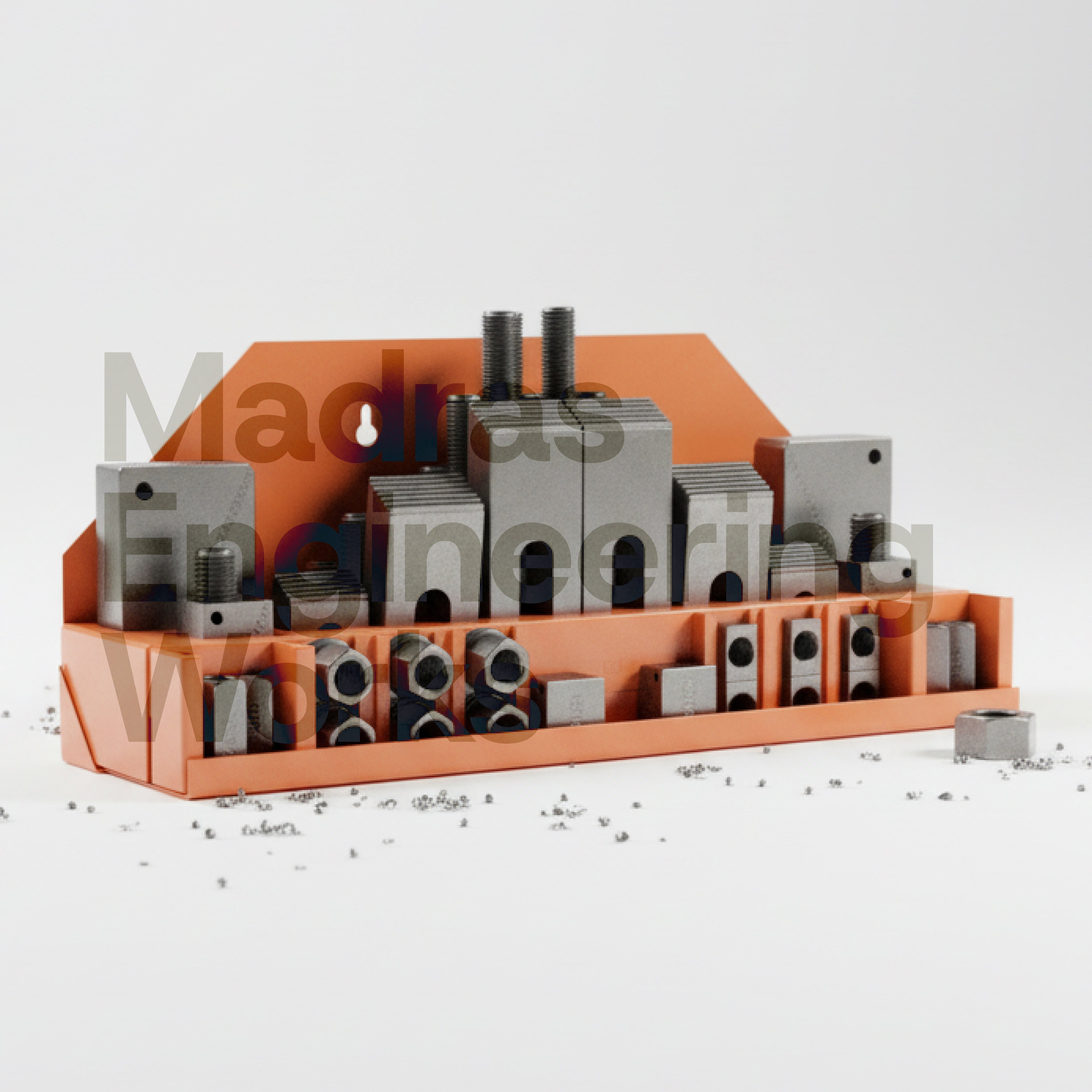
It is part of almost every standard 58-piece clamping kit used in Indian CNC and VMC shops.
To learn the basics of clamping elements, check:
👉 What Are Clamping Elements?
How a Flat Strap Clamp Works (Mechanics Explained Clearly)
A strap clamp converts the tensile load (pulling force) of a stud into downward and slightly horizontal clamping force onto the workpiece.
Here’s the breakdown:
1. T-Nut in the Table
A T-nut sits in the machine’s T-slot.
2. Stud Screws Into the T-Nut
The stud passes through the slot in the strap clamp.
3. Heel Support (Step Block)
The back of the clamp sits on a step block or packing.
👉 Use step blocks for proper leveling
👉 Step Block Set
4. Tightening the Nut
When you tighten the nut:
-
The clamp pivots slightly
-
Downward force pushes the job against the table
-
Reaction force goes into the step block
Result: Strong, rigid, low-profile clamping suitable for heavy milling.
To understand different clamp types, read:
👉 Types of CNC Clamps
Technical Specs of Flat Strap Clamps (Indian Standard)
Most strap clamps used in Indian CNC shops, including Chennai, Coimbatore and Hosur, follow:
Material
-
EN8 / C45 medium carbon steel
-
Alloy steel for heavy duty
-
Mild steel for low load jobs
Heat Treatment
-
28–35 HRC (hardened for rigidity)
Finish
-
Blackodised / black phosphate
-
Some premium clamps have ground faces
Common Sizes
-
M8, M10, M12, M16, M20
-
Clamping ranges: 0–125 mm
-
Holding capacity: ~1 to 1.6 tonnes per clamp
For stud sets and T-bolts, check:
👉 Stud + Nut Set
Where Flat Strap Clamps Are Used (South India Examples)
Chennai (Ambattur, Sriperumbudur, Gummidipoondi)
Used widely in:
-
automotive machining
-
general engineering
-
job shops
-
VMC clamp kits
Coimbatore
Common in:
-
pump manufacturers
-
textile machinery machining
-
sub-plate and fixture clamping
Hosur
Used for:
-
earth-moving components
-
automotive OEMs & ancillaries
-
heavy milling setups
General India-wide CNC/VMC Usage
-
Clamping billets and blocks directly
-
Holding fixtures, angle plates & sub-plates
-
Machining irregular castings
For slippage-related issues, check:
👉 Preventing Workpiece Slippage
Advantages of Flat Strap Clamps
✔ Cost-effective
Most affordable and widely available clamp type.
✔ Very versatile
A single set can clamp hundreds of differently shaped jobs.
✔ High load capacity
Handles heavy roughing cuts and drilling.
✔ Strong & reliable
Minimal bending, great rigidity for VMC usage.
✔ Works with standard accessories
Step blocks, studs, flange nuts, T-nuts.
Problems That Strap Clamps Solve
✔ Workpiece vibration
Strong downward force reduces chatter.
✔ Poor holding on vises
Clamps irregular jobs vises cannot grip.
✔ Slippage during milling
Perfect for heavy cuts, large parts, long jobs.
✔ Budget-friendly fixturing
Indian MSMEs prefer strap clamps over expensive fixtures.
Common Operator Mistakes (Seen in Chennai Shops)
❌ Heel lower than job
If heel height is incorrect, clamp lifts the job.
❌ No packing under soft/thin jobs
Leads to bending or scratches.
❌ Using long studs
Long studs flex → poor force transfer → vibration.
❌ Undersized T-nuts
Risk of pull-out during heavy milling.
❌ Not enough clamps
Long plates clamped only at ends will vibrate.
When NOT to Use a Flat Strap Clamp
Avoid strap clamps when:
✔ You need very low profile
They take vertical space → bad for 5-axis or tall setups.
✔ Part is very thin or delicate
May deform. Use:
-
vacuum chucks
-
magnetic chucks
-
soft jaws
✔ High-repeatability automotive lines
Better:
-
zero-point systems
-
hydraulic clamps
-
precision vises
✔ Machine/pallet has no T-slots
Need grid plate adapters or modular fixtures.
Flat Strap vs Step Clamp vs U-Clamp
| Feature | Flat Strap Clamp | Step Clamp (Stepped Strap) | U-Clamp |
|---|---|---|---|
| Shape | Flat bar | Stepped body | U-shaped |
| Height Adjustment | Separate step blocks | Built-in steps | Minimal |
| Best For | General milling/VMC | Repetitive jobs | Pipes, rods, brackets |
| Setup Speed | Medium | Faster | Fast but limited |
| Machines | CNC, VMC, milling | CNC/VMC | Fabrication, automotive |
To Conclude
A Flat Strap Clamp is one of the most reliable, affordable, and versatile clamping tools for CNC and VMC machining — especially in South Indian industrial clusters.
Whether you're machining billets in Ambattur, castings in Coimbatore, or fixtures in Hosur, strap clamps remain the backbone of secure and stable workholding.
For workshops across all of Chennai, Madras Engineering Works is the trusted manufacturer and retail supplier for high-quality strap clamps, step blocks, studs, T-bolts and complete clamping kits.
Explore the full range here:
👉 Flat Strap Clamp
👉 Clamping elements
For enquiries or bulk orders:
enquiry@madrasengg.com
Text/WhatsApp: +91 95143 73702


0 comments