

In CNC and VMC machining, T-bolts and stud + T-nut systems use the same T-slot, but their load path, flexibility, and real-world behavior are very different.
In Indian workshops—especially job shops across Chennai, Coimbatore, and Hosur—choosing the wrong system can lead to job slippage, damaged T-slots, tool breakage, and safety risks.
This guide explains how each system works, where each one excels, and how Indian CNC operators should choose correctly.
What Is a T-Bolt and How It Works
A T-bolt is a one-piece fastener with a forged or machined T-shaped head designed to fit directly into a CNC machine table’s T-slot. The threaded shank projects upward to accept a nut or clamp.
When tightened:
-
The T-head bears directly against the underside of the T-slot lips
-
The bolt works mainly in tension
-
The T-head takes bearing and shear loads
-
Clamping force is transferred straight into the table and workpiece
Properly sized T-bolts closely match the slot width and height, maximizing contact area and minimizing slot damage.
🔗 Here's a Detailed T-Bolt Guide
What Is a Stud + T-Nut System and How It Works
A stud + T-nut system separates the anchoring and clamping functions:
-
A T-nut sits inside the T-slot
-
A threaded stud screws into the T-nut
-
Clamps, step blocks, and nuts build the stack above the table
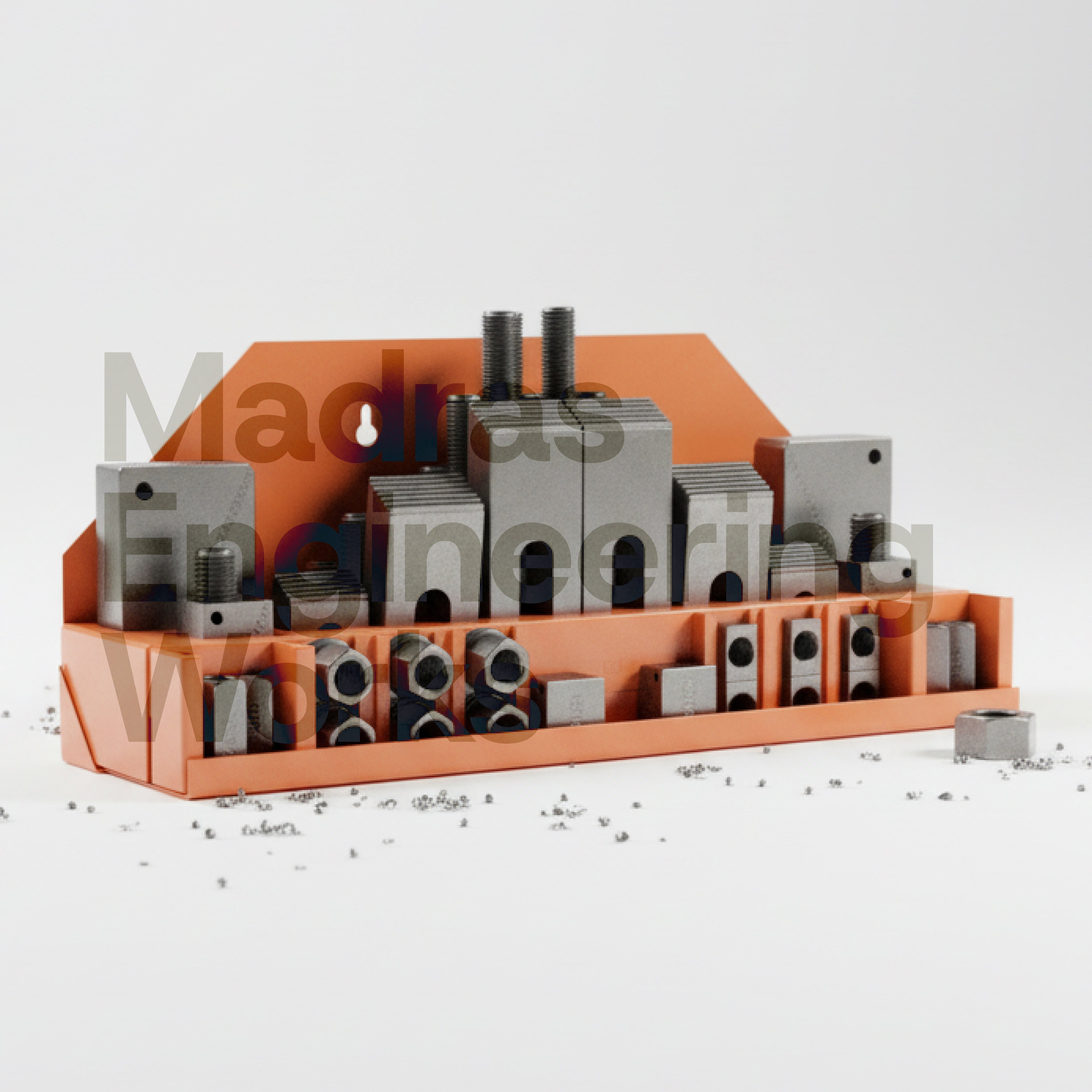
This modular system is the backbone of 58-piece CNC clamping kits widely used in India.
Advantages:
-
Multiple stud lengths for different job heights
-
Easy replacement of individual parts
-
One kit supports many machines and fixtures
Mechanical Load Path Comparison (Critical Difference)
T-Bolt Load Path
Clamp → Nut → Bolt shank (tension) → Integral T-head → Slot lips → Machine table
-
No thread interface at slot level
-
Lower stress concentration
-
Stiffer, more compact stack
Stud + T-Nut Load Path
Clamp → Nut → Stud (tension + bending) → Stud–T-nut threads → T-nut body → Slot lips → Table
-
Threads become a critical stress point
-
Failure often starts at first engaged thread
-
More sensitive to nut quality and engagement depth
🔗 T-Slot Sizes & Stud Selection
🔗 MEW Smart Spec - T-Slot Sizes & Stud Selection Calculator
Strength, Safety & Common Failures in Indian CNC Shops
In Indian CNC workshops, failures are rarely due to bolt strength alone. Most incidents are caused by poor setup and operator practices.
Common Problems Seen in India
-
Job lifting due to steep clamp angles
-
Stud pull-out from low-quality T-nuts
-
Slot lip chipping on older VMC tables
-
Mixing 10.9 studs with soft nuts
-
Over-tightening without step blocks
Older imported machines in Coimbatore and Hosur often show T-slot damage caused by incorrect clamping geometry, not weak fasteners.
🔗 Strap Clamp Geometry & Step Block Usage
When T-Bolts Are the Better Choice
T-bolts are preferred when:
-
Mould & die clamping is repetitive
-
Fixtures remain semi-permanent
-
Low-profile clamping is required (Z-clearance)
-
Horizontal machining centers or rotary tables are used
-
Dedicated bolt lengths reduce setup error
In Chennai’s mould and die clusters, T-bolts are often paired with mould clamps for daily repeat setups.
🔗 Mould Clamps & Heavy CNC Clamping
When Stud + T-Nut Systems Are Better
Stud + T-nut systems dominate Indian job shops because they offer:
-
Maximum flexibility
-
One kit for multiple machines
-
Easy replacement from local suppliers
-
Compatibility with step blocks and strap clamps
Shops handling 20–50 job types per month rely on stud kits because they eliminate the need for custom bolts.
Material Grades Commonly Used in India
Standard Indian practice includes:
-
EN8 / C45 steel
-
Heat-treated and black-oxidised finish
-
Property class 8.8 for general use
-
Property class 10.9 for heavy machining
Ungraded or 4.6 hardware—still found in small shops—poses serious safety risks, especially with modern carbide tooling.
🔗 Fastener Grades for CNC Workholding
Common Operator Mistakes (India-Specific)
-
Less than 1× diameter thread engagement
-
No step block under clamp heel
-
Clamp too far from workpiece
-
Mixing old T-nuts with new studs
-
Chips/oil under clamp contact area
These mistakes multiply bending loads, not tensile loads—leading to unpredictable failures.
🔗 Levelling Jacks vs Step Blocks
Cost & Availability in India
| System | Typical Cost (India) | Replacement Ease |
|---|---|---|
| Stud + T-Nut Kit | ₹3,500–₹6,000 | Very easy |
| Individual T-Bolts | Size-specific | Moderate |
Most shops reserve T-bolts for fixtures and rely on stud kits for daily work.
Real-World Practice in Indian CNC Shops
-
Chennai & Sriperumbudur: Dedicated T-bolts for mould clamps
-
Coimbatore: Stud kits for pump & casting jobs
-
Hosur: Heavy T-bolts for die blocks, studs for general machining
Shops that document slot size → stud size → clamp force charts see far fewer failures.
Practical Selection Rule (India-Focused)
Use T-Bolts when
-
Fixture is repetitive
-
Low stack height matters
-
Setup must be rigid and foolproof
Use Stud + T-Nut when
-
Job mix is high
-
Clamp height changes daily
-
Cost and flexibility matter
Why This Matters for Chennai CNC Shops
At Madras Engineering Works, we supply T-bolts, T-nuts, studs, strap clamps, step blocks, and levelling jacks as both manufacturer and retail supplier across all of Chennai.
Choosing the right system protects your machine table, tooling, operators, and production quality.
📧 enquiry@madrasengg.com
📞 +91 9514373702


0 comments