

Levelling jacks are precision mechanical supports used under clamps and fixtures to adjust and stabilise workpiece height on CNC and VMC tables. Unlike fixed step blocks, levelling jacks provide continuous, repeatable height control — essential when multiple part thicknesses or fine tolerances are involved. This guide explains types, specs, load calculations, operator errors, and best-practice selection specifically for Indian machining hubs (Chennai, Coimbatore, Hosur, Bangalore, Pune).
What is a Levelling Jack & Why Use One?
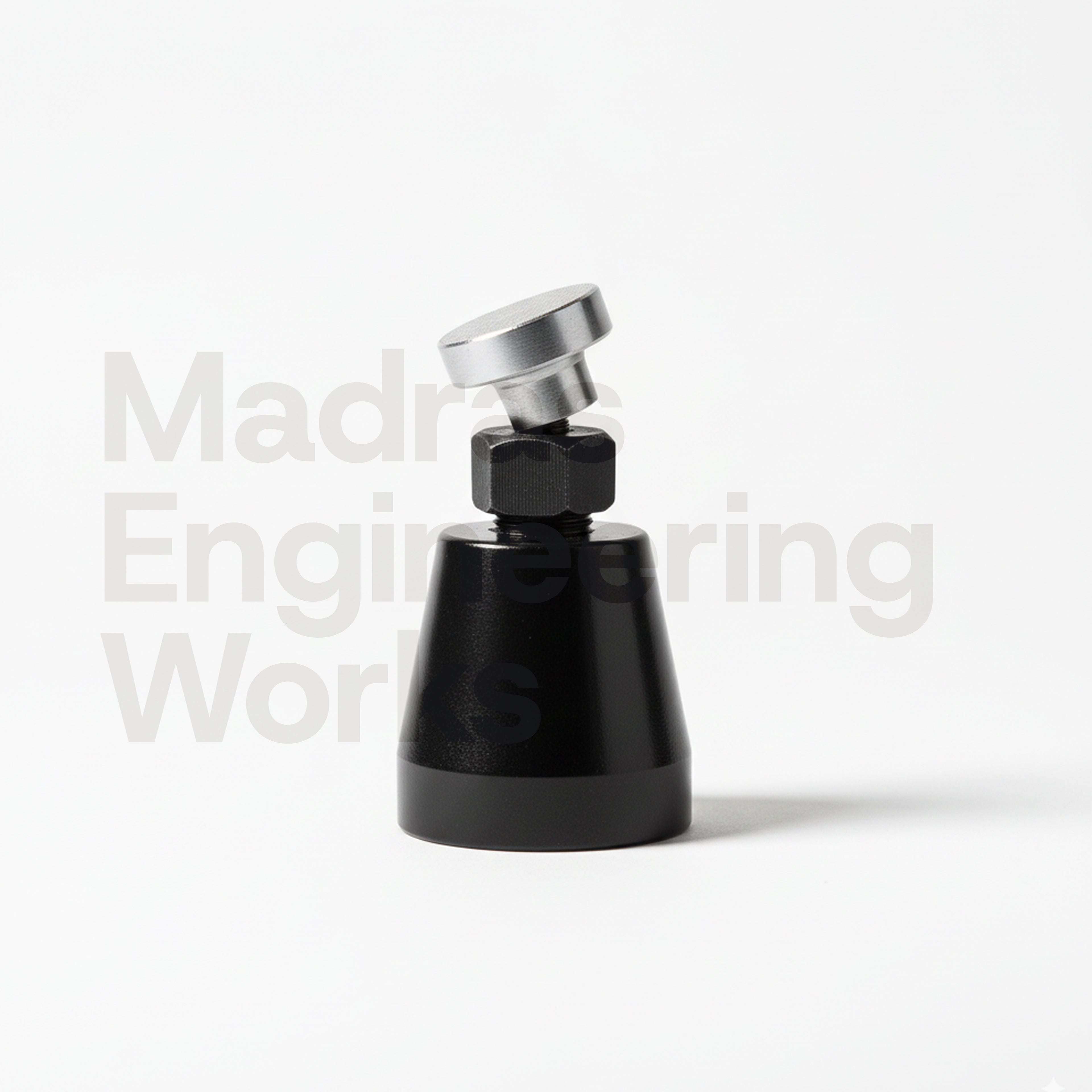
A levelling jack is a threaded spindle assembly (commonly trapezoidal M24–M32) that raises/lowers by rotating a nut or spindle, giving fine height control (typical pitch 2–3 mm → 0.5–1.5 mm lift/rev). Use levelling jacks when you need:
-
Continuous height adjustment and repeatability (±0.1 mm possible with precision variants).
-
Fast setup across multiple part heights without swapping step blocks.
-
Stable support for heavy clamp arms or tall fixtures.
For reference → Levelling Jack
Main Levelling Jack Types (India-focused)
-
Standard Flat-Top (SBSJ-40 / SBSJ-190)
-
Height: 100–150 mm | Load: ~5 tons | Thread: M24
-
Use: General milling, job shops.
-
Price ballpark: ₹1,070–1,370.
→ SBSJ
-
-
-
Height: 160–230 mm | Load: 8–10 tons | Thread: M32
-
Use: Large die/mould, heavy castings
-
-
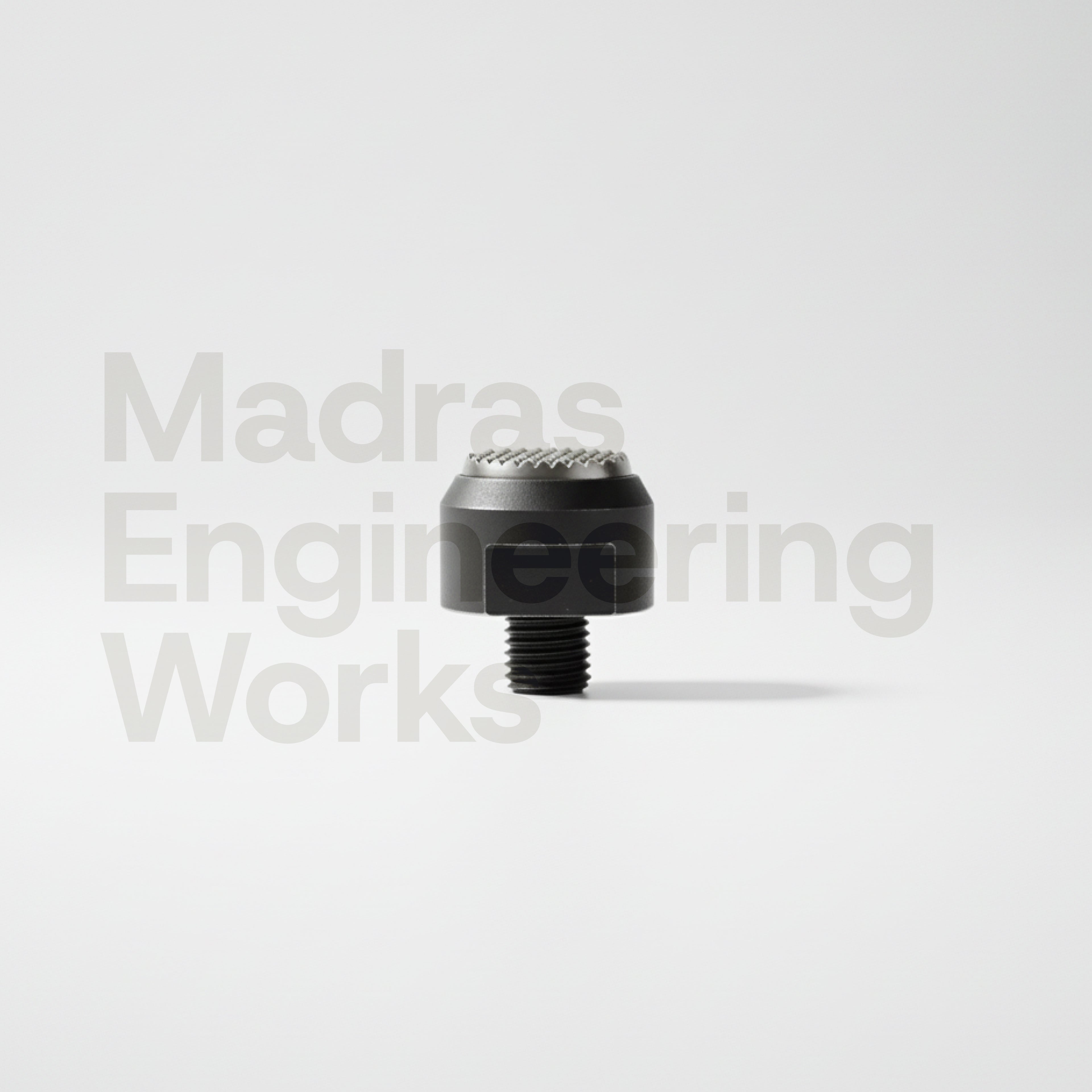
Fine-Adjustment (Precision Variant)
-
Height: 50–100 mm | Load: 3–5 tons | Fine pitch for ±0.1 mm repeatability
-
Use: Toolrooms, inspection, precision moulds
-
-
-
Height: 120–170 mm | Load: 5 tons | Top: conical point
-
Use: Positioning/centering of cylindrical parts
-
-
-
Height: 105–155 mm | Load: 5 tons | Top: V-groove
-
Use: Cylindrical raceways, shaft support—more stable than conical under cutting
-
Height Ranges & Typical Use (Quick Table)
| Type | Closed → Open (mm) | Travel (mm) | Typical Use |
|---|---|---|---|
| LJ-1 Standard (SBSJ) | 100 → 150 | 50 | General VMC setups |
| LJ-HD Heavy (BBLN) | 160 → 230 | 70 | Heavy dies, large VMC |
| Fine-Adjust | 50 → 100 | 50 | High precision toolrooms |
| Conical (CES-SCL) | 120 → 170 | 50 | Cylindrical parts |
| V-Top (CES-CHSB) | 105 → 155 | 50 | Precision round parts |
Materials, Heat Treatment & Durability
-
Body: Normalized mild steel (good machinability), black-oxide finish.
-
Spindle: EN8 / C45 – induction hardened (surface HRC 45–55) for wear resistance.
-
Knurled nut: Hardened for long life.
-
Top pad: Induction hardened HRC 45–50 to resist clamp indentation.
Good-quality jacks survive 20,000+ cycles; cheap ones with annealed spindles fail <1,000 cycles.
Load Capacity & Selection Rules
Rule of thumb: select jacks with an axial rating comfortably above expected sustained loads — use a safety factor of ×2.
| Stud/clamp scenario | Recommended jack |
|---|---|
| Light precision set (per jack load <1 ton) | Fine-adjust |
| Typical multi-clamp VMC (per jack 0.5–1.5 ton) | Standard 5T |
| Heavy die/roughing (per jack >1.5 ton) | LJ-HD 8–10T |
Quick calculation example:
If 4 clamps generate total clamping load 1.8 tons → each jack carries 0.45 t → use 5T jacks (safety factor ×2 → 0.9 t requirement satisfied).
When to Use Levelling Jacks vs Step Blocks vs Packing Plates
-
Levelling jacks: variable heights, frequent changeovers, repeatability, precision.
-
Step blocks: fixed, quick, low cost — best for repeated identical batches.
-
Packing plates/shims: permanent fixtures and low-cost one-offs.
Decision flows provided in the research show levelling jacks pay back quickly when jobs vary (ROI days–weeks).
Common Operator Mistakes & How to Prevent Them
-
Incorrect jack height selection → unstable cantilevering.
-
Fix: use fine-adjust jacks for thin parts or stack height blocks correctly.
-
-
Uneven load transfer (jacks out of level) → taper/tilt on parts.
-
Fix: adjust in diagonal pairs; use machinist level and straight edge.
-
-
Back-rotation under clamp load → height loss/crash.
-
Fix: ensure keyway engaged; use knurled nut with positive lock; inspect threads.
-
-
Side loads & overturning moments → jack failure.
-
Fix: avoid offset loading; use multiple jacks under long clamp arms; prefer M32 HD jacks for long arms.
-
-
Thread stripping / cross-threading → expensive repairs.
-
Fix: de-load before reversing; use smooth, slow rotations.
-
-
Corrosion in coastal shops → seized spindles.
-
Fix: SS spindle variants, rust-preventive oil, lockbox storage.
-
Real Indian Use Cases & ROI Example
-
Chennai job shop: levelling jacks reduce daily setup time from 80 → 24 minutes across mixed-thickness runs — payback in under one week on saved labour.
-
Coimbatore pump maker: conical-top jacks for shaft centring; V-top for impeller finish.
-
Hosur die shop: LJ-HD for heavy die clamping, reduced stacking issues and tool crashes.
Maintenance Checklist (Monthly / Quarterly / Annual)
-
Monthly: lubricate spindle (ISO VG 32), wipe rust, check keyway engagement.
-
Quarterly: check thread backlash, measure top pad wear, replace knurled nut if play detected.
-
Annual: hardness test/replace spindle on heavy-use jacks (>15k cycles).
Quick Buyer’s Checklist (Before Purchase)
-
Required closed→open height & travel
-
Axial load rating with safety factor ×2
-
Thread size (M24 for standard; M32 for heavy-duty)
-
Top type: flat / V-top / conical
-
Material & surface hardening specs (EN8/C45 spindle, induction hardening)
-
Local stock & lead time (Chennai distributor preferred)
-
Warranty and spare-spindle availability
To Conclude,
Levelling jacks are a low-cost, high-impact upgrade for Indian CNC/VMC shops that demand flexibility across varying part heights. When specified and used correctly — matching load rating, height, and top type (flat/V/conical) — they dramatically reduce setup time, improve part accuracy and extend tooling life.
Contact Madras Engineering Works for stock, bulk pricing and customised jack assemblies across Chennai and South India.
📩 enquiry@madrasengg.com • 📞 +91 95143 73702
→ Contact Page


0 comments