

Screw Jack Types for Machining: Which Head, Lock & Base for Your Setup (India Guide)
Every Indian tool room has screw jacks. Most have one type, used for everything. That works until a casting tips mid-cut because a flat-head jack couldn't grip the irregular datum, or a batch of components comes out with 0.1mm dimensional variation because a vibrating spindle crept two threads over a 4-hour run. There are eleven screw jack types for machining in MEW's range, each with a specific head, locking mechanism, base configuration, or thread type. This guide covers the selection logic across all of them.
If you need an introduction to what a screw jack does and when machining requires one, start with the Screw Jack for Milling Machine guide.
Three Selection Decisions — Head, Lock, Base
- Head type — what does the contact face look like, and how does it match the workpiece datum surface?
- Locking mechanism — does the set height need to be positively locked against vibration-induced creep?
- Base configuration — does the jack need to be bolted down, or does a wider footprint provide enough stability?
Decision 1 — Head Type: Swivel, Conical, or Flat
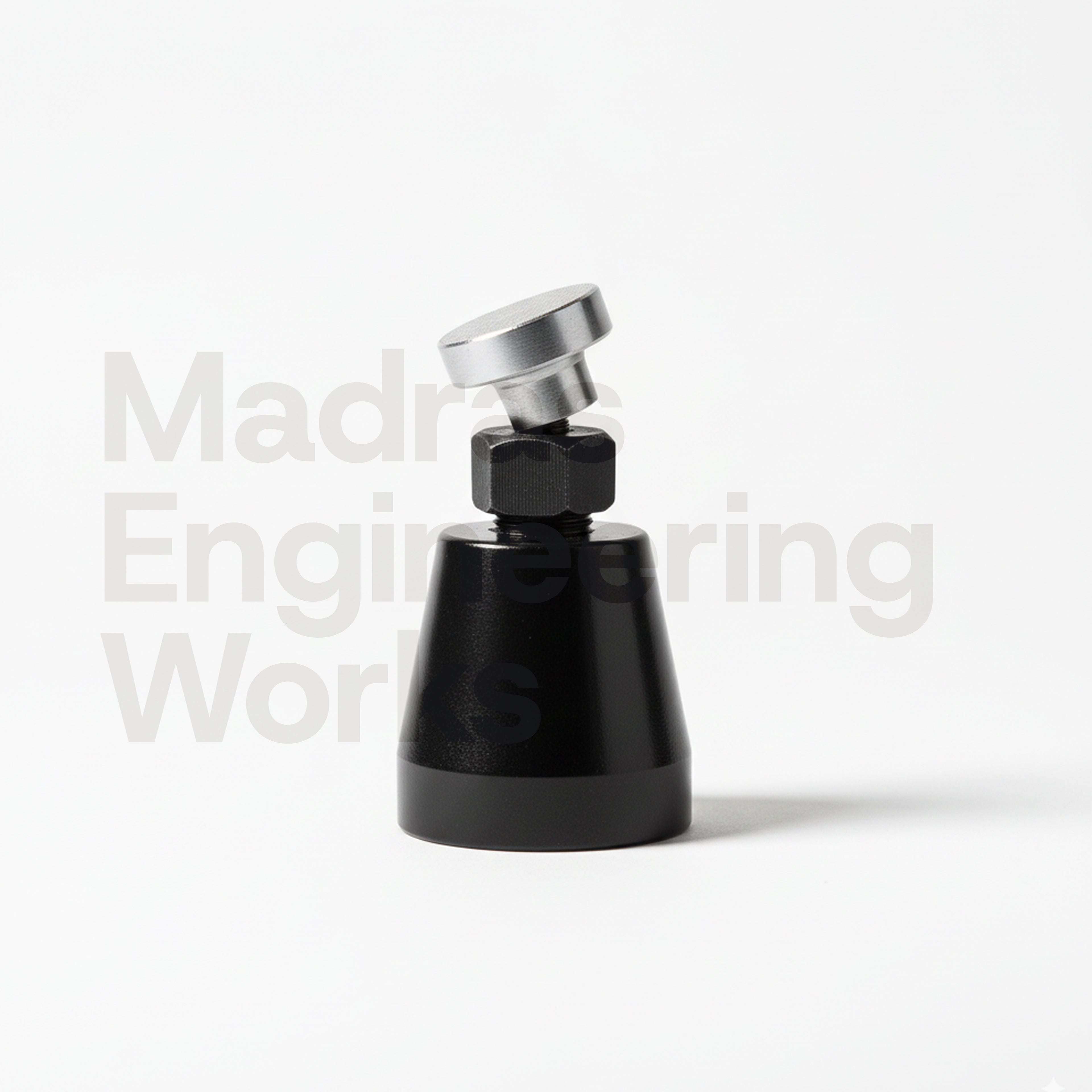
Swivel Head (CES-STSB-45): For Non-Flat and Angled Datum Surfaces
The swivel head is a self-aligning ball-seated tip. The contact face floats on a ball bearing and rotates freely to match any surface angle. Diamond serrations grip the workpiece. A stopper prevents the spindle from disengaging fully during operation — if the spindle unscrews fully during a cut, the workpiece drops suddenly.
This is the correct head for castings, forgings, weldments, and any workpiece whose datum surface is not perfectly flat or parallel to the machine table.
- SKU: CES-STSB-45, ₹525
- Best for: Castings, forgings, weldments with non-parallel or angled datum surfaces. VMC and HMC machining, surface grinding, inspection setups.
Conical Head (CES-CHSB-40 and CES-SCL-65): For Workpieces with a Centre Hole
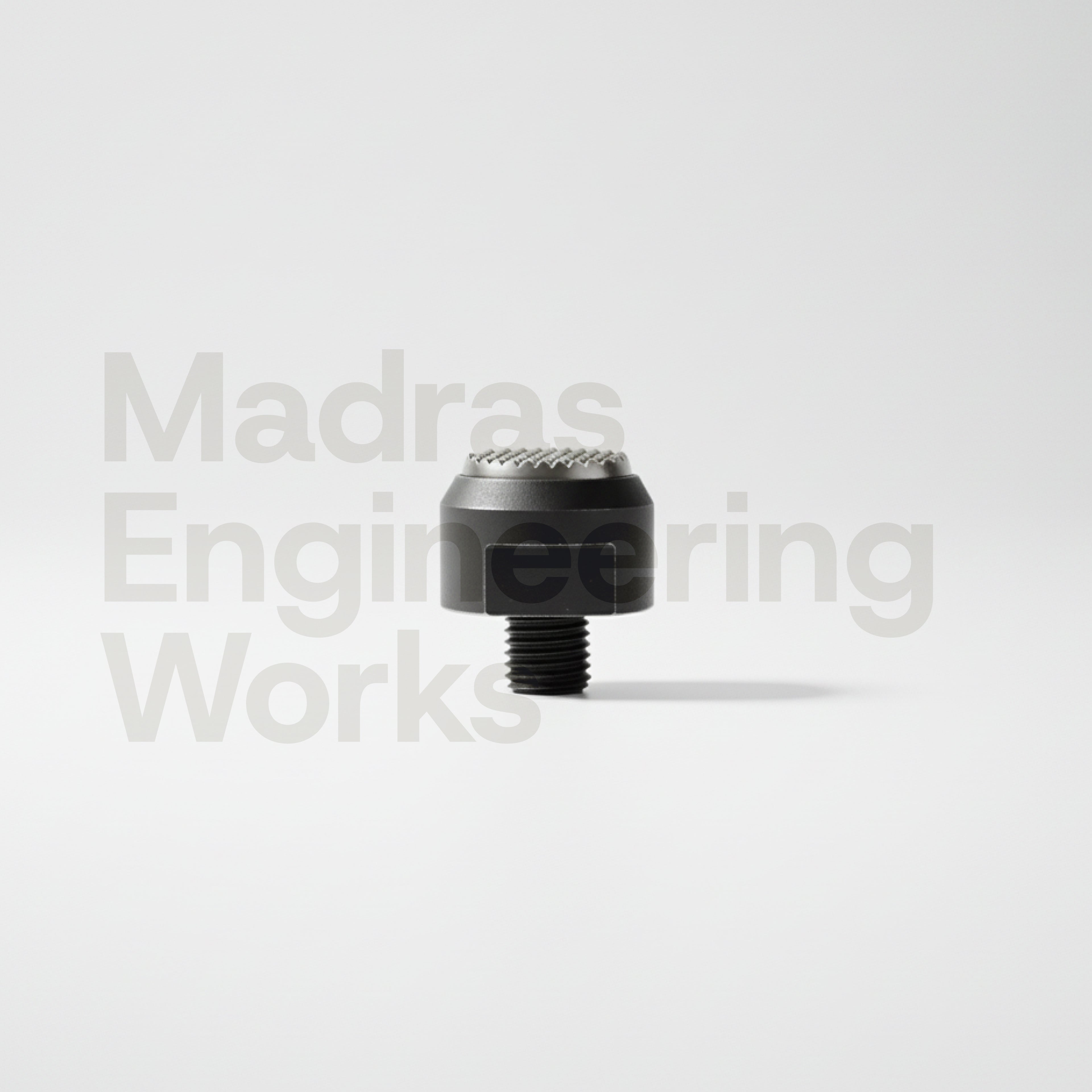
The conical tip engages a pre-drilled centre hole or conical recess in the underside of the workpiece. The cone-in-hole contact provides both vertical support and lateral position control from a single jack — preventing lateral slip on smooth-bodied or polished workpieces where a flat or swivel-head jack would rely on friction alone.
- CES-CHSB-40: ₹405 — conical head, no lock nut. For tool room and light machining use.
- CES-SCL-65: ₹960 — conical head + lock nut + stopper. For precision milling where height must be locked and spindle retention is required.
- Requirement: Workpiece must have a pre-drilled centre hole or conical recess.
Flat/Standard Head (CES-SBSJ-40): For Parallel, Machined Datum Surfaces
The flat spindle tip is the correct choice when the workpiece datum surface is flat, machined, and parallel to the machine table. Do not use on castings with rough or angled datum surfaces — this is how a workpiece tips mid-cut under a correctly tightened clamping setup.
- SKU: CES-SBSJ-40, ₹605. Thread: Trapezoidal.
Not sure which head type suits your workpiece? WhatsApp a photo of the datum surface to +91 95143 73702.
Decision 2 — Locking Mechanism: None, Lock Nut, or Brass Locking Screw
No Lock: Thread Friction Only
Standard screw jacks hold their height through the self-locking property of the trapezoidal thread. Adequate for light to medium machining loads, tool room setups, and inspection applications where vibration levels are low.
Lock Nut: Positive Height Locking for Heavy and Sustained Machining
Under sustained heavy milling, machine vibration slowly overcomes self-locking thread friction. The spindle rotates by a fraction of a turn per hour. Over a long roughing operation, this spindle creep changes the support height — and the workpiece shifts. Dimensional variation accumulates across the batch. The lock nut eliminates this by mechanical constraint.
Lock nut variants: CES-SJLN-60 (₹870), CES-SCL-65 (₹960), CES-50SF-100 (₹2505), CES-50DF-200 (₹4955), CES-BBLN-160 (₹4495).
Brass Locking Screw: Thread Protection on the Heaviest Jack
The heavy-duty double-flange jack (CES-70DF-200, ₹8980) uses a brass set screw. At the clamping loads this jack carries, a conventional steel lock nut requires very high torque — enough to cause steel-on-steel galling between the lock nut and spindle thread over repeated service cycles. The brass set screw is softer than the steel spindle and deforms slightly against it when tightened, locking position without steel-on-steel contact. The thread survives the high-cycle service life of a production heavy-machining jack.
Decision 3 — Base Configuration: Standard, Flanged, or Broad Base
Standard Body: Free-Standing Support
Sits on the machine table without bolting. Suitable for most tool room, light milling, and inspection setups.
Single Side Flange (CES-50SF-100): One-Side Bolting in Confined Layouts
The single-side flange extends from one side with a bolt hole — preventing lateral shift while fitting in confined fixture layouts. SKU CES-50SF-100, ₹2505.
Double Side Flange (CES-50DF-200 and CES-70DF-200): Maximum Bolted Stability
Flanges on both sides allow secure bolting from both sides — maximum lateral stability for a bolted screw jack. Specified for heavy workpieces where the combined downward load and lateral cutting force would cause an unbolted jack to tip or rotate.
- CES-50DF-200: Lock nut locking. ₹4955.
- CES-70DF-200: Brass locking screw. ₹8980.
Broad Base with Lock Nut (CES-BBLN-160): Stability Without Bolting
Significantly wider footprint — providing stability against tipping under heavy workpiece loads without needing to be bolted down. Use when heavy workpieces require stable support and bolting is not practical. SKU CES-BBLN-160, ₹4495.
The Quality Layout Jack — A Different Tool for a Different Environment
The Quality Layout Jack (CES-QSJ-50) is for surface plates and CMM tables for dimensional inspection, layout marking, and first-article verification — not machining loads. It uses Vee Rolled threads instead of trapezoidal threads. Vee threads have a finer pitch per revolution, meaning one turn moves the head a smaller linear distance. For precision positioning during dimensional measurement, this fine adjustment resolution matters. The self-locking strength of trapezoidal threads is not required when the load is component weight only, not cutting force.
- SKU: CES-QSJ-50, ₹540. Thread: Vee Rolled. Best for: surface plate layout, CMM setup, inspection fixtures.
Screw Jack Pads (CES-P-1): Three Types, Three Jobs
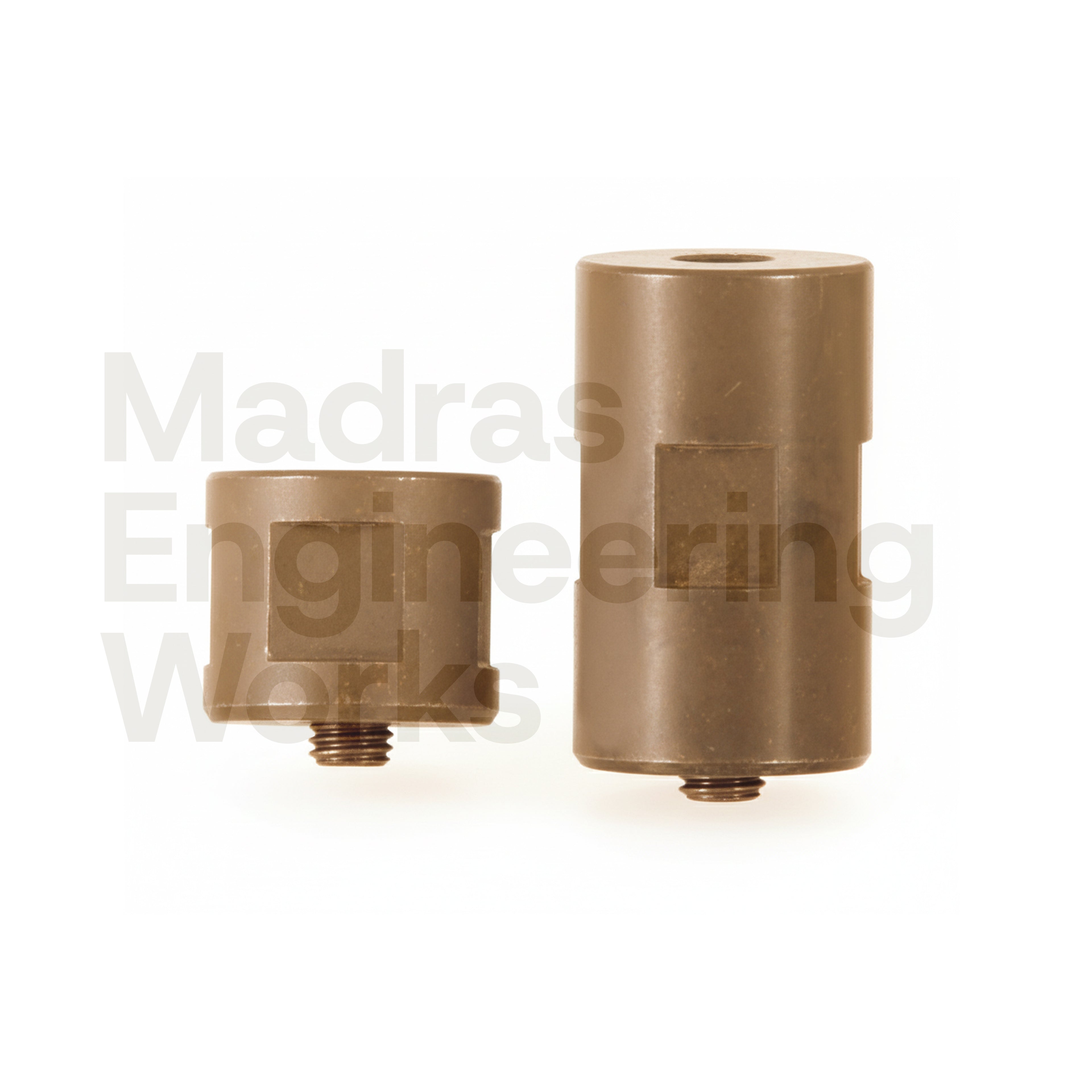
- Coupling Pad (P-6): Increases height of standard screw jacks by stacking. Used when the adjustment range is insufficient for the workpiece height.
- Locating Pad (P-8/14): Suitable for holding clamps with slot width 14mm.
- U-Clamp Pad (P-/26): Suitable for U-Clamps with slot width 26mm and above.
Selection Summary
| Scenario | Correct Jack | SKU |
|---|---|---|
| Casting / forging with non-flat datum surface | Swivel Head | CES-STSB-45 |
| Shaft / turned component with centre hole | Conical Head | CES-CHSB-40 |
| Conical head + height lock + stopper | Conical Head + Lock Nut | CES-SCL-65 |
| Flat machined datum, general milling support | Standard Flat Head | CES-SBSJ-40 |
| Heavy sustained milling — height must stay locked | Lock Nut Jack | CES-SJLN-60 |
| Surface plate, CMM, inspection | Quality Layout Jack | CES-QSJ-50 |
| Must be bolted one side — confined fixture space | Single Side Flange + Ring Lock Nut | CES-50SF-100 |
| Heavy workpiece — bolt down both sides | Double Side Flange + Lock Nut | CES-50DF-200 |
| Heaviest loads — thread protection required | Double Side Flange + Brass Locking Screw | CES-70DF-200 |
| Heavy workpiece, no bolt points available | Broad Base + Lock Nut | CES-BBLN-160 |
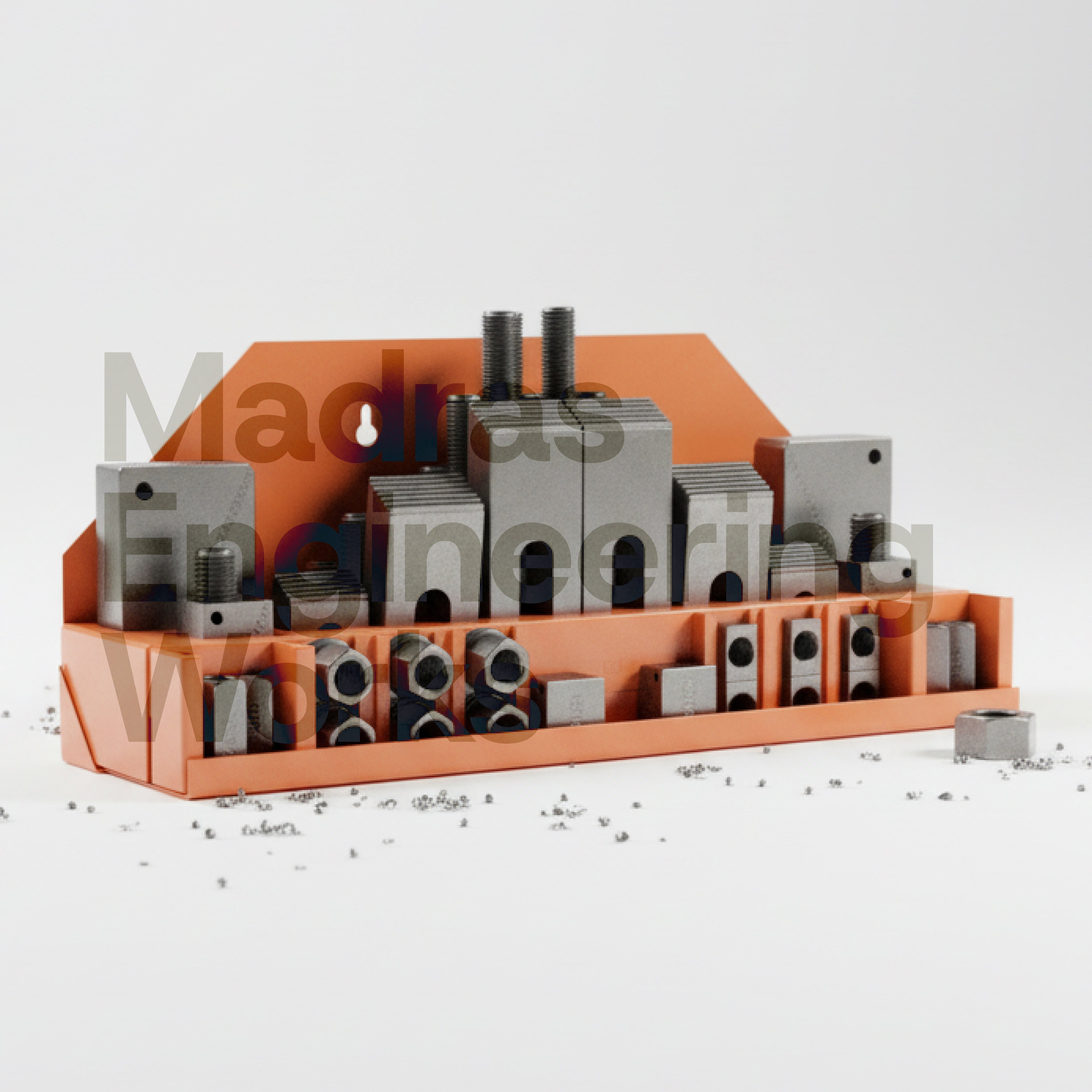
Browse MEW's full range of screw jacks and workpiece support components. To find your complete clamping kit by machine model in 30 seconds, use the Smart-Spec calculator. See the Workholding Clamps for CNC India guide and the Milling Fixture Clamps guide for the complete workholding picture.
Frequently Asked Questions
What is the difference between a swivel head and a conical head screw jack?
A swivel head self-aligns to any surface angle — correct for castings, forgings, and weldments with non-flat datum surfaces. A conical head engages a pre-drilled centre hole, providing both vertical support and lateral position control — used for turned components and precision blanks where a flat or swivel head could slip laterally.
When does a screw jack need a lock nut?
A lock nut is needed for heavy or sustained milling loads where machine vibration could cause spindle creep, changing the support height over time. For light loads and inspection environments, the self-locking trapezoidal thread is sufficient.
Why does the heavy-duty screw jack use a brass locking screw instead of a lock nut?
At extreme loads, a steel lock nut requires very high torque that can gall the steel spindle thread over repeated service cycles. The brass set screw deforms slightly against the spindle rather than engaging metal-on-steel contact, preserving the thread through high-cycle heavy service.
What is the quality layout screw jack used for?
The Quality Layout Jack (CES-QSJ-50) is for surface plate layout, CMM setup, and inspection fixtures. It uses Vee Rolled threads for finer height adjustment resolution per spindle turn. Do not substitute a machining jack in inspection applications — the adjustment is too coarse.
When should I use broad base screw jacks instead of standard screw jacks?
Use a broad base jack (CES-BBLN-160) when supporting heavy workpieces where bolting to the fixture plate is not practical. The wider base footprint resists the tipping moment without bolting. If bolting is possible, a flanged jack provides greater stability for the most demanding loads.
Written by Husain, Founder of Madras Engineering Works — ISO 9001:2015 certified industrial supplier in Chennai. WhatsApp +91 95143 73702 or email enquiry@madrasengg.com.

0 comments