

T-slot damage in CNC and VMC machine tables is almost never caused by weak machine design. In Indian job shops, tool rooms, and mould shops, damaged T-slots are usually the result of wrong clamping geometry, overload, poor-quality hardware, and incorrect operator practices on brittle cast-iron tables.
Once a T-slot is damaged, repair is expensive and often impractical. Understanding why T-slots fail—and how to prevent it—can save Indian manufacturers lakhs in machine repair costs, downtime, and resale value loss.
🔗 CNC workholding components overview
This guide is written specifically for Indian CNC/VMC users operating machines from BFW, Jyoti CNC, Ace Micromatic, LMW, Haas India, and similar brands.
What T-Slot Damage Really Looks Like in Indian CNC Shops
On CNC/VMC tables across India, T-slot damage typically appears as:
1. Chipped or Broken Slot Lips
Small or large pieces break away from the top edges of the T-slot, especially at frequently used clamping locations.
2. Widened or Bell-Mouthed Slots
The slot opening becomes wider or tapered, causing T-nuts and T-bolts to rock or tilt instead of seating flat.
3. Cracked Slot Web (Severe Cases)
Cracks propagate along the thin web beneath the slot lips, sometimes rendering the entire slot unusable.
🔗 DIN 650 T-slot standard reference
⚠️ Important:
Unlike worn studs or clamps, T-slot damage is irreversible without table re-machining or inserts—rarely economical for Indian job shops.
How Load Paths Destroy T-Slots
T-slots are standardized under DIN 650, designed so that clamping loads flow safely into the table only when clamp geometry is correct.
Intended Load Path
Clamp → Stud/T-bolt (tension) → T-nut/T-head (bearing & shear) → Cast-iron table (compression)
What Goes Wrong
Cast iron is strong in compression but weak in tension and shock. When clamping geometry is incorrect, loads shift into tensile stress at the slot lips, causing cracks and breakage.
🔗 Studs, T-nuts, and T-bolts explained
The Biggest T-Slot Killers in Indian CNC/VMC Shops
1. Missing or Incorrect Step Blocks
When the rear of a strap clamp is unsupported or set too low:
-
Clamp becomes steep
-
Vertical force converts into upward prying force
-
Slot lips go into tension → chipping begins
This is the single biggest cause of T-slot damage in India.
🔗 Step blocks for CNC clamping – selection guide
2. Over-Tightening with Long Spanners
Using long spanners or cheater pipes on M12–M16 studs:
-
Exceeds safe clamp force easily
-
Overloads T-slot lips instead of improving holding
Many T-slots crack without any cutting force, purely during tightening.
🔗 IS 1367 fastener strength standards
3. Wrong Stud or T-Nut Size for the Slot
Common Indian shop mistakes include:
-
M16 studs forced into 18 mm slots
-
Locally fabricated thick T-nuts
-
Undersized or worn T-nuts that tilt under load
Result: high stress concentration on one slot lip.
🔗 T-slot size vs stud size chart for VMCs - Calculator
4. Poor Thread Engagement
Studs engaging only a few threads into the T-nut lead to:
-
Thread stripping
-
Sudden pull-out
-
Impact damage to the slot
Rule of thumb: minimum one stud diameter of full thread engagement.
🔗 Correct stud length selection for CNC clamping
5. Dirty Tables, Chips, and Oil
Chips or oil reduce friction, forcing operators to tighten harder.
Result: slot lips take the punishment instead of friction doing the work.
🔗 CNC clamping safety checklist
T-Bolts vs Stud + T-Nut Systems: How Each Damages Slots
T-Bolts
-
Load transfers directly through the T-head
-
Poor clamp angle causes lip prying
-
Repeated use at fixed locations causes localized chipping
🔗 T-bolts for CNC machines in Chennai
Stud + T-Nut Systems
-
Stud mainly in tension
-
T-nut takes shear and bearing
-
Failures often start with stripped nuts or bent studs
-
Undersized T-nuts still chip slot lips
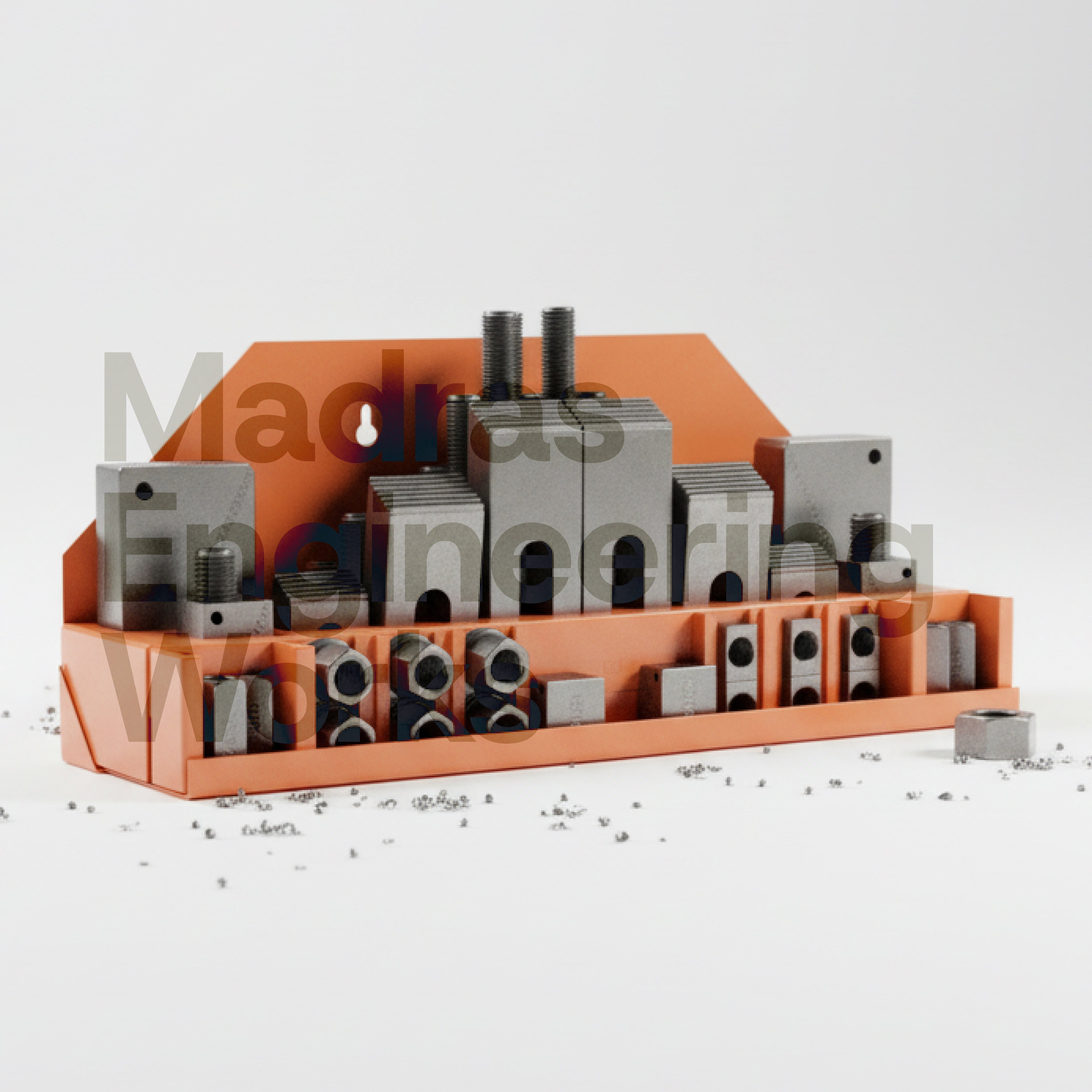
🔗 58-piece CNC clamping kits explained
➡️ Key Insight:
Bad geometry damages the table. Hardware type only determines what fails first.
Real Patterns from Indian CNC Job Shops
-
Used VMCs from Coimbatore and Hosur often show chipped slots near mid-table
-
Mixed branded + local hardware accelerates slot wear
-
Mould shops using dedicated T-bolts without step blocks see repeated lip breakage
-
Machines with damaged tables suffer lower resale value
Why T-Slot Damage Is a Serious Business Risk
Accuracy
-
Poor seating of T-nuts
-
Fixture tilt
-
Loss of re-clamping repeatability
Safety
-
Reduced engagement height
-
Sudden clamp release
-
Risk to operators and spindle
Resale Value
-
Table damage signals abuse
-
Buyers discount or reject machines
Tool-Room Best Practices to Prevent T-Slot Damage
Correct Hardware
-
DIN 650-compatible T-nuts and T-bolts
-
EN8 / C45 hardened material
-
IS 1367 grade 8.8 (standard), 10.9 (heavy roughing)
Correct Geometry
-
Clamp nearly horizontal
-
Front contact close to job
-
Rear supported with correct step blocks
-
Avoid steep clamp angles (>15°)
Correct Practice
-
Avoid cheater pipes and impact guns
-
Clean table and slots before clamping
-
Scrap bent studs and cracked T-nuts immediately
💡 Treat the CNC table as the fuse you must never blow.
Recommended Setup for Indian VMCs
For BFW, Jyoti, Ace, LMW, Haas India machines:
-
T-slots: 16–22 mm (verify machine plate)
-
Studs: M10–M16
-
Thread engagement: ≥1× diameter
-
Step blocks: mandatory
-
Hardware grade: 8.8 baseline, 10.9 for heavy cuts
🔗 CNC clamping selection guide – India
Final Takeaway
T-slot damage is not bad luck—it is bad clamping practice.
With correct geometry, proper EN8/C45 hardware, and disciplined tightening, CNC/VMC tables can last decades even in high-mix Indian job shops.
About Madras Engineering Works
Manufacturer & Supplier of CNC Workholding, T-Bolts, T-Nuts, Studs & Clamping Kits
📍 Chennai, Tamil Nadu
📞 +91 9514373702
📧 enquiry@madrasengg.com


0 comments