
Shoulder Bolts for Jigs and Fixtures India: Precision Location, Ball Elements, Support Bolts & Hook Clamps
Standard workholding — T-bolts, strap clamps, step blocks, studs — solves most machining setups. But fixture design regularly throws up problems that the standard stack cannot solve: a casting that rocks on every load because the datum surface is irregular, a clamping point buried under a raised wall, a guided sliding assembly that needs a precision bearing element. This guide covers shoulder bolts, self-aligning ball elements, support bolts, and hook clamps — with verified specs and the engineering reasoning behind each one.
Metric Shoulder Bolt — Grade 12.9 (SKU M1-M5 X 10): Precision Location and Guided Motion
A shoulder bolt is a precision-ground fastener with three distinct zones: a hex socket drive head, an unthreaded precision shoulder section, and a threaded shank shorter than the shoulder. The shoulder is the functional element. The thread merely retains the bolt.
The precision-ground shoulder engages a reamed hole in the mating component — a jig bush, sliding plate, or movable fixture element — with a controlled fit. This provides accurate, repeatable location every time the mating component is loaded, assembled, or cycled.
Why Grade 12.9, not 8.8: Grade 12.9 alloy steel has hardness of 39–44 HRC versus 22–33 HRC for 8.8. In a production fixture, the shoulder bolt carries bearing loads at the shoulder-to-bore interface through thousands of cycles. A harder shoulder surface resists wear, maintaining location accuracy over the fixture's intended service life. Specifying 8.8 in a high-cycle fixture means the shoulder wears faster and location accuracy degrades progressively.
The specification ordering mistake: The most common procurement error in India is ordering by thread size when the fixture design specifies the shoulder diameter. If your reamed guide bore is 12mm, you need a shoulder bolt with a 12mm shoulder — not an M12 thread. An M12 thread shoulder bolt may have a shoulder of 16mm, 18mm, or 20mm depending on the manufacturer's range. Use the MEW Shoulder Bolt Finder — it selects by shoulder diameter, thread size, shoulder length, and application.
- SKU: M1-M5 X 10 (M5 thread × 10mm shoulder length)
- Material: Alloy Steel Grade 12.9
- Drive: Hex socket
- Standard: ISO 7379 / DIN 9841
- Applications: Jigs and fixtures, injection mould tools (stripper plates, ejectors), press tool die sets, robotic end-of-arm tooling, CNC fixture plates
Designing a fixture and not sure which shoulder diameter fits your reamed bore? Use the MEW Shoulder Bolt Finder or WhatsApp your bore size and application to +91 95143 73702.
Self Aligning Ball Element (T3-SBE-6): Stable Three-Point Contact on Rough Datums
A casting or forging comes off the foundry with an irregular datum surface — rough, slightly curved, with high spots and hollows. Three rigid fixed support pads on this surface cannot all contact simultaneously. The workpiece rocks on whichever two high spots happen to contact, and the third pad is in the air. Machined dimensions vary batch to batch.
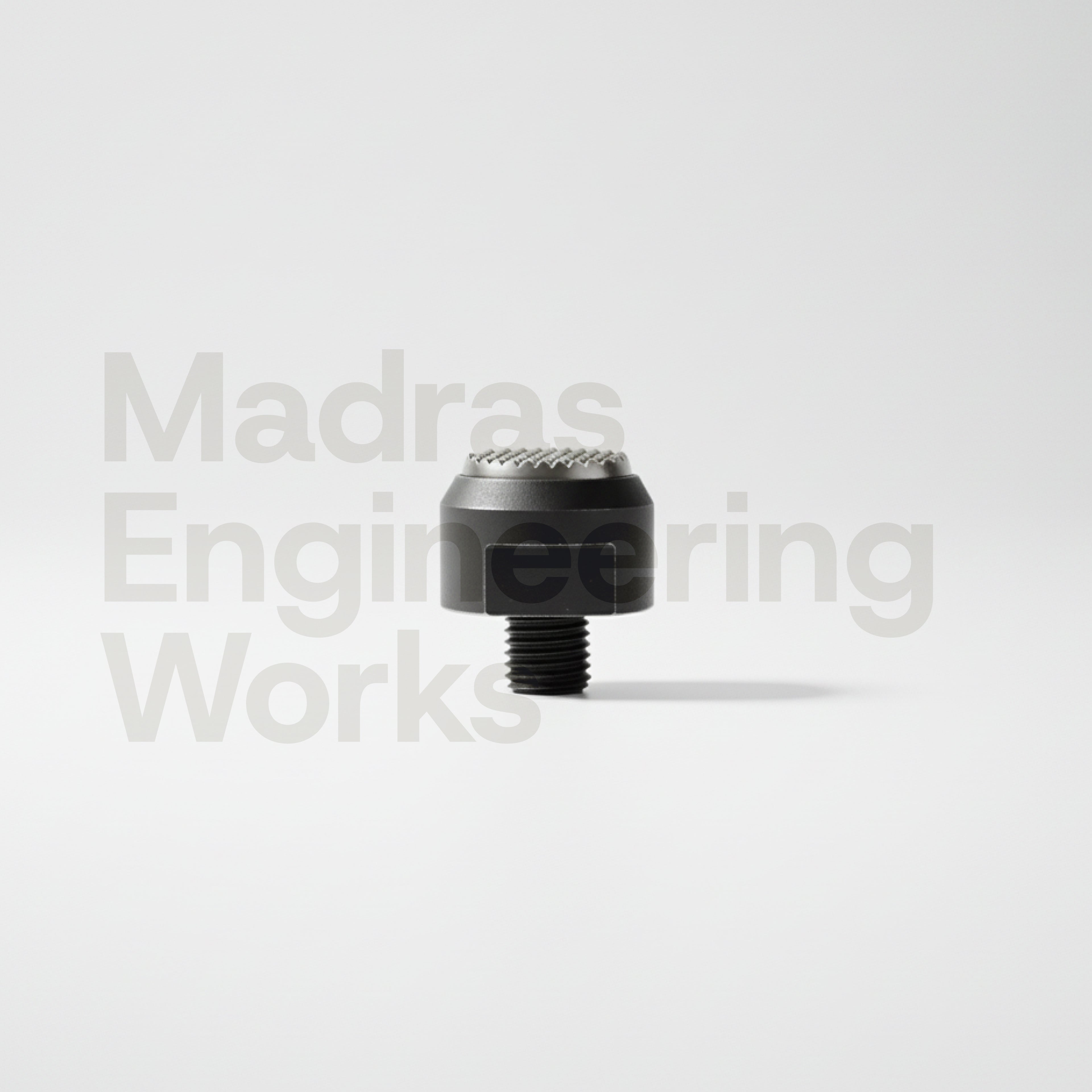
The self-aligning ball element has a hardened steel ball in a toughened steel body. The ball floats in a socket and rotates to match any surface angle within its range. In a correctly designed casting fixture, two primary datum contacts are fixed rigid pads (establishing the datum plane) and the third is a self-aligning ball element. The two fixed pads define the datum plane; the ball element provides stable third-point contact wherever the casting surface happens to be — automatically, every load cycle, without pre-machining the casting datum surface.
- SKU: T3-SBE-6, ₹635
- Ball: Hardened and Tempered steel
- Body: Toughened steel, chemically blackened
- Applications: Casting and forging fixtures, CNC machining centres, milling fixtures, inspection setups, assembly jigs
Support Bolt (T2-SB-1655): Adjustable Datum Point Support
When a workpiece datum has slight irregularities — not the severe irregularity of a rough casting, but the kind of variation in a semi-finished blank or weldment — it rocks on the highest contact points. The rocking is subtle: the workpiece appears seated, but under clamping force it snaps to one contact orientation or another. Machined datums vary between setups.
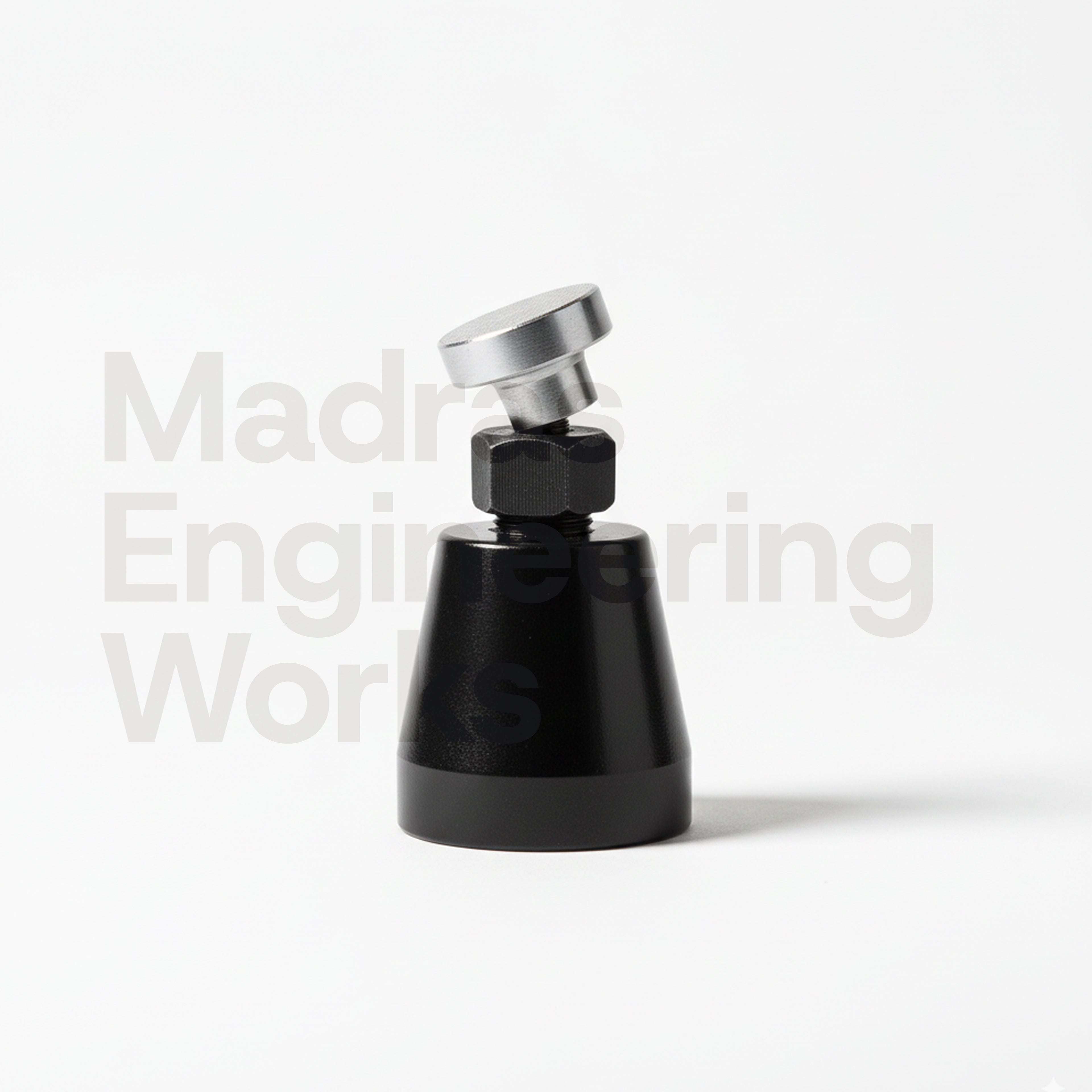
A support bolt screws into a tapped hole in the fixture plate and can be adjusted in height within its thread range. By raising or lowering each support bolt independently, you bring all three primary datum contacts into simultaneous contact with the workpiece — eliminating the rock without modifying the workpiece or fixture plate geometry. Lock each bolt at the correct height, and the fixture provides repeatable datum contact for every component in the batch.
- SKU: T2-SB-1655, ₹149
- Material: Medium carbon steel, hardened and tempered to 24–32 HRC, chemically blackened
- Applications: CNC machining fixtures, inspection setups, tool room applications
Hook Clamp (T1-HK-1642): Clamping Where Strap Clamps Cannot Reach
Every fixture designer eventually faces this: the correct clamping point is buried behind a raised wall, under a lip, or inside a recess that blocks straight clamp access. A strap clamp requires a clear straight path from the step block to the clamping point. If the workpiece geometry prevents that path, the standard strap clamp is simply not usable at that location.
The hook clamp's curved profile hooks over or under a workpiece edge, lip, or recess. The hook engages from the accessible side and applies clamping force from an angle that a straight clamp cannot approach. Particularly useful for:
- Components with raised flanges or bosses where the clamping point is inside a recess
- Automotive castings with complex external geometries that block straight clamp access
- Die and mould cavities where adjacent fixture elements prevent straight clamp positioning
- SKU: T1-HK-1642, ₹695
- Applications: CNC machining fixtures, jig construction, tool room setups for workpieces where conventional straight clamping is blocked by geometry
When to Use Each Precision Location Element
| Problem | Component | SKU |
|---|---|---|
| Need accurate, repeatable part location or guided motion in jig/fixture/mould/die | Shoulder Bolt Gr 12.9 | M1-M5 X 10 |
| Casting or forging datum surface is irregular — workpiece rocks on three rigid pads | Self Aligning Ball Element | T3-SBE-6 |
| Semi-finished workpiece datum has slight variation — rocks on high spots between setups | Support Bolt | T2-SB-1655 |
| Clamping point inaccessible — raised wall, recess, or lip blocks straight clamp | Hook Clamp | T1-HK-1642 |
These precision location elements complement the standard workholding stack. See the Workholding Clamps for CNC India guide, the Milling Fixture Clamps guide, and the Screw Jack Types guide.
Frequently Asked Questions
What is a shoulder bolt used for in jigs and fixtures?
A shoulder bolt provides precision location and guided motion in jigs, fixtures, moulds, and dies. The precision-ground unthreaded shoulder engages a reamed hole with a controlled fit, providing accurate, repeatable positioning. In press tool stripper plates and injection mould ejectors, the shoulder guides linear sliding motion. Use the MEW Shoulder Bolt Finder to select by shoulder diameter — not thread size.
Why do shoulder bolts for jigs and fixtures need to be Grade 12.9?
Grade 12.9 (39–44 HRC) resists wear at the shoulder-to-bore interface faster than Grade 8.8 (22–33 HRC). In production jig or die sets running thousands of cycles, a harder shoulder maintains location accuracy over the fixture's intended service life. An 8.8 shoulder wears faster, and location accuracy degrades progressively, requiring fixture rebuild sooner than designed.
When should I use a self-aligning ball element instead of a fixed support pad?
Use a self-aligning ball element when the workpiece datum surface is irregular or rough — as with castings and forgings. The best practice is to use two fixed pads (defining the datum plane) and one self-aligning ball element at the point of highest surface variation, so that consistent three-point primary datum contact is achieved on every load cycle.
How does a hook clamp work when a strap clamp cannot reach?
A hook clamp's curved profile engages over a workpiece edge, under a lip, or into a recess that blocks straight clamp access. It contacts the workpiece from the accessible side and applies clamping force from an angle that a straight clamp cannot approach.
What is the difference between a shoulder bolt and a dowel pin for fixture location?
A dowel pin is interference-fit and flush-mounted — intended for permanent location. A shoulder bolt is thread-retained and removable with a hex key. Choose a shoulder bolt when the location element must be replaceable during the fixture's service life, or when removability for jig maintenance is required.
Written by Husain, Founder of Madras Engineering Works — ISO 9001:2015 certified industrial supplier in Chennai. WhatsApp +91 95143 73702 or email enquiry@madrasengg.com.

0 comments