
Workholding Washers and Nuts for Milling: Which One, When, and Why (India Guide)
The nut and washer at the top of a clamping stud are the most ignored components in an Indian tool room. They are also the reason some jobs move mid-cut when nothing else seems wrong — the clamp is in the right place, the step block height is correct, the stud is the right length. But the wrong washer embeds under clamping torque, the nut loses preload, and the workpiece shifts. Workholding washers and nuts for milling are not interchangeable commodity parts. Seven variants exist in MEW's catalogue, each designed for a specific failure mode or application.
Quick Reference: All Seven Types
| Component | SKU | Hardness | Defining Feature | Use When |
|---|---|---|---|---|
| C-Washer | T3-CW-M8 | 35–42 HRC | Open slot — slides off stud sideways | Production changeover: skip full nut removal |
| Spherical Washer Set | T3-SWCS-8 | 35–42 HRC | Convex + concave pair self-aligns to bolt axis | Angled clamp surface; tilted stud axis |
| Thick Plain Washer | T1-TPW-1615 | 35–42 HRC | Heavy section; resists embedding deformation | High clamping torque; heavy milling loads |
| Plain Washer DIN | T3-PW-DIN-M6 | 35–42 HRC | Standard DIN dimensions | General-purpose standard-load workholding |
| Flanged Hex Nut | T2-FHN-818 | 24–32 HRC | Integrated flange — washer built in | Production setups; vibration-prone environments |
| High Nut | T2-HN-812 | 24–32 HRC | Tall body — double thread engagement depth | High-load joints where thread stripping is a risk |
| Extension Nut | T2-EN-824 | 24–32 HRC | Long body — reaches short stud projection | Minimal stud thread projection beyond clamp stack |
C-Washer (T3-CW-M8): Production Changeover Without Removing the Nut
The C-washer is named for its shape — an open C with a radial slot running from the centre hole to the outer edge. That slot allows the washer to slide sideways over the clamping stud without passing over the nut end. In production, the sequence becomes: back off the nut two or three turns, rotate the C-washer to align the slot with the stud, slide it sideways off, change the workpiece, slide it back on, re-tighten. The nut never comes off. In production runs of 20–100 pieces, this time saving per cycle compounds into real machine time recovered per shift.
- SKU: T3-CW-M8
- Material: Low carbon steel, case hardened 35–42 HRC, chemically blackened
Want to confirm which C-washer size fits your stud? WhatsApp a photo of your setup to +91 95143 73702.
Spherical Washer Set (T3-SWCS-8): When the Stud Is Not Perpendicular
A standard flat washer assumes the stud is perpendicular to the clamping surface. When it isn't — because the clamp sits at a slight angle, the workpiece surface is stepped, or the stud tilts slightly in the T-nut — a flat washer makes contact on one edge only. That is line contact, not face contact, and it introduces bending stress into the stud shank.
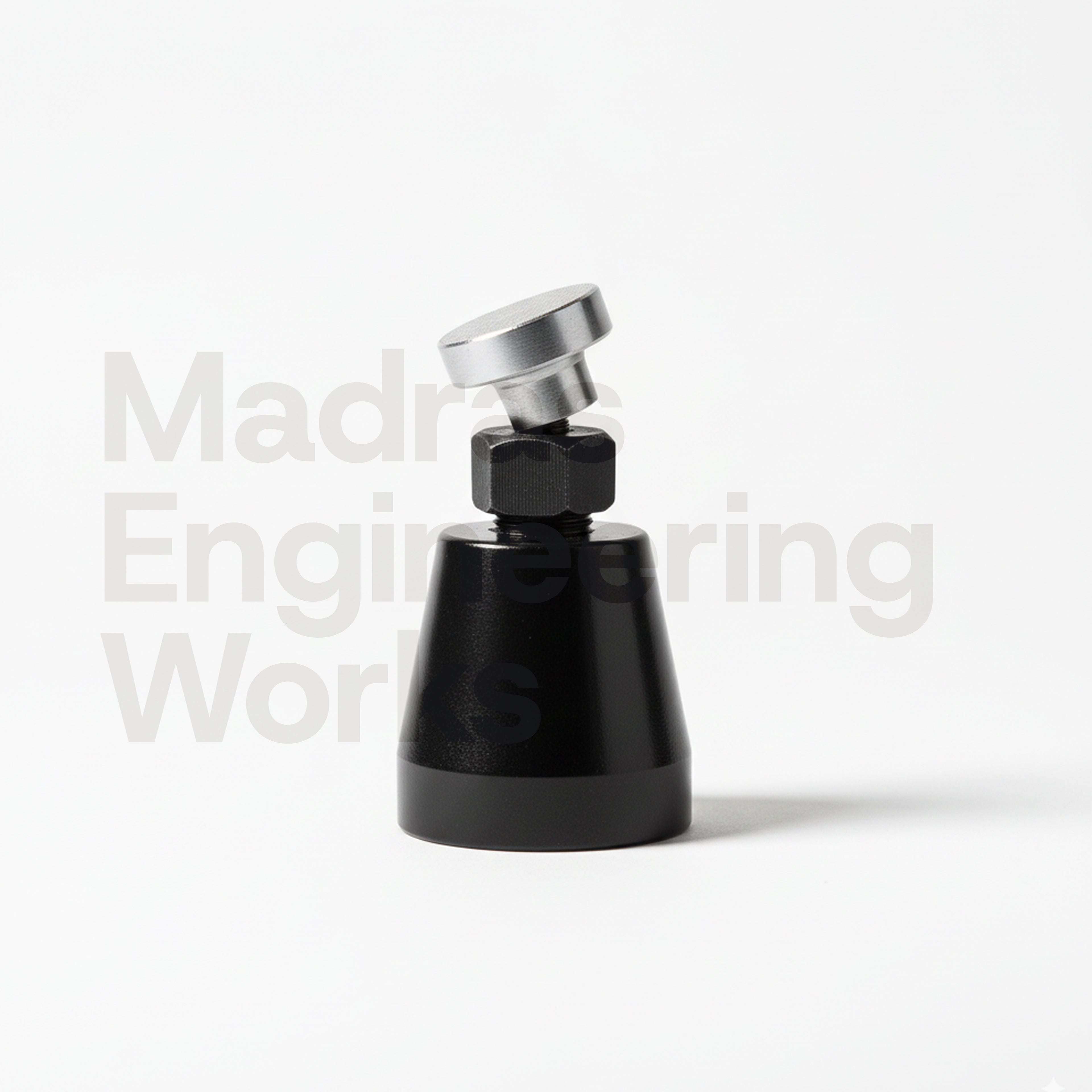
The spherical washer set is a matched pair: a convex spherical washer (dome) and a concave conical seat washer (cup). Together they form a ball-in-socket interface that self-aligns to correct approximately 3 degrees of angular deviation. Standard: DIN 6319 C/D.
Critical orientation warning: The convex (dome) face must point DOWN toward the conical seat, and the concave (cup) face must point DOWN against the clamp surface. If the two washers are flipped, the assembly acts as two rigid wedges that amplify the angular offset rather than correcting it. This orientation error is invisible once assembled and will not be caught by visual inspection.
- SKU: T3-SWCS-8
- Material: Low carbon steel, case hardened 35–42 HRC, chemically blackened
Thick Plain Washer (T1-TPW-1615): Preventing Preload Loss from Embedding
A thin commercial washer under high clamping torque embeds — the contact asperities flatten and compress under clamping pressure, the nut settles, and bolt preload drops. Research in fastener engineering puts this preload loss at potentially 50% or more depending on surface condition and loading. This is why a job can feel properly clamped at setup but allows a 0.1–0.2mm workpiece shift after the spindle starts — vibration finishes the embedding process that the initial torque started.
A thick, case-hardened washer at 35–42 HRC is harder than the clamp surface it bears against. It does not significantly deform under full clamping torque, and the nut does not settle.
- SKU: T1-TPW-1615
- Material: Low carbon steel, case hardened 35–42 HRC, chemically blackened
- Use for: Heavy milling, roughing cuts, press tool workholding — any application where maximum clamping torque is applied
Plain Washer DIN (T3-PW-DIN-M6): Standard General-Purpose
The standard DIN plain washer is the correct choice for general-purpose workholding at normal load levels — conventional milling, drilling, light roughing. When clamping forces are at the upper end, specify the Thick Plain Washer instead.
- SKU: T3-PW-DIN-M6, ₹16. Material: Low carbon steel, case hardened 35–42 HRC, chemically blackened.
Flanged Hex Nut (T2-FHN-818): One Component Instead of Two
The flanged hex nut has an integrated wide flange at the bearing face — a built-in washer that cannot be lost, forgotten, or assembled in the wrong orientation. In a busy tool room, separate washers disappear between changeovers. The flanged nut eliminates this failure mode. The larger flange bearing area also provides better resistance to vibration-induced loosening than a standard nut.
- SKU: T2-FHN-818, ₹33. Material: Medium carbon steel, hardened and tempered 24–32 HRC, chemically blackened.
High Nut (T2-HN-812): Double Thread Engagement for High-Load Joints
The high nut's tall body provides approximately double the thread engagement of a standard nut. Distributing the load across twice as many thread flanks pushes the thread-strip load well beyond the stud's own yield point — the nut will never be the weak link in the joint.
- SKU: T2-HN-812, ₹16. Material: Medium carbon steel, hardened and tempered 24–32 HRC, chemically blackened.
- Use for: High-load clamping joints, press tool workholding, heavy VMC milling
Extension Nut (T2-EN-824): When the Stud Thread Projection Is Short
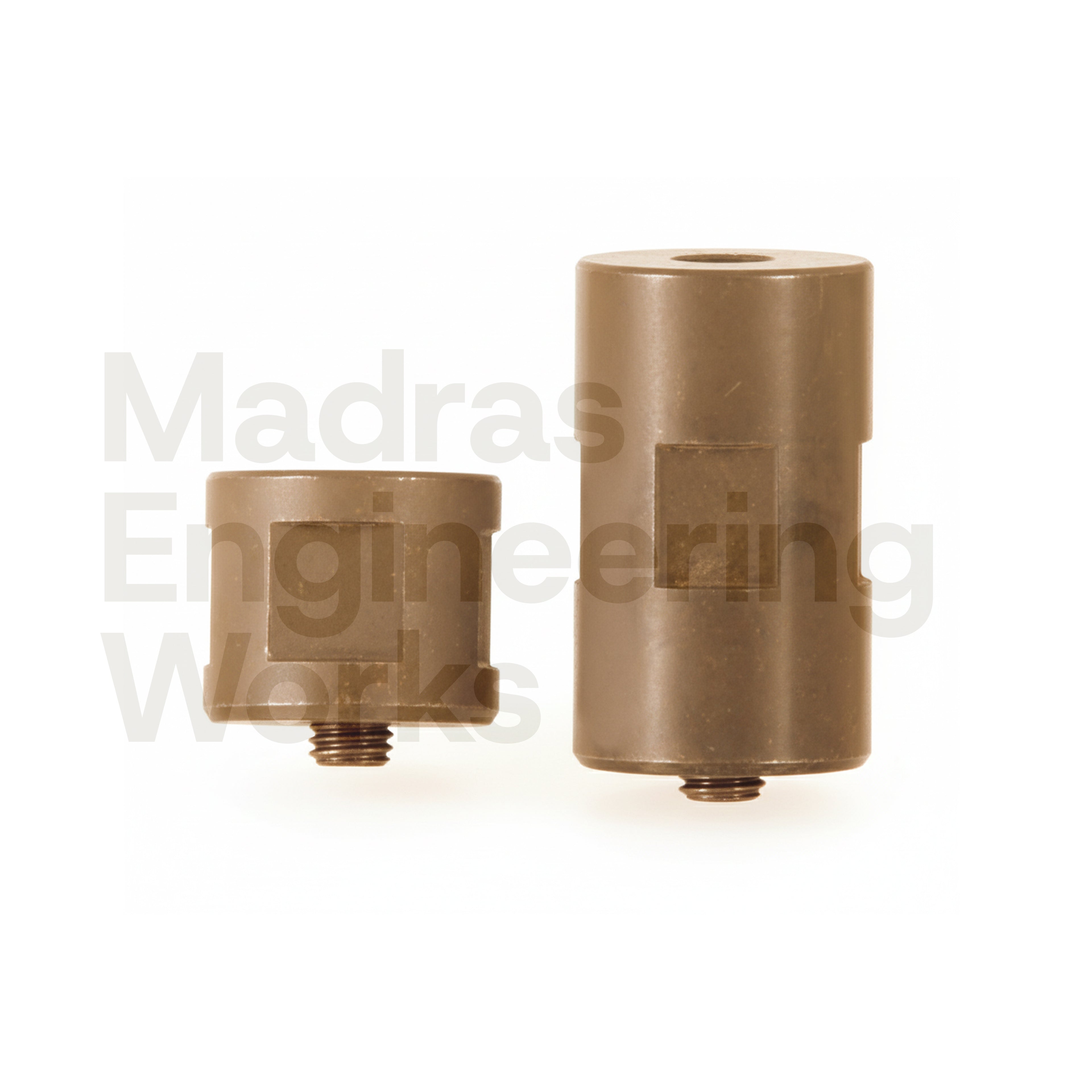
When a clamping stud has insufficient thread projection above the clamp stack, a standard nut may only engage 3 or 4 threads — not safe under full clamping torque. The extension nut is a long-body hex nut that reaches down over the stud thread, engaging as many threads as are available even when projection is short. Full engagement is restored without changing the stud or step block configuration.
- SKU: T2-EN-824, ₹28. Material: Medium carbon steel, hardened and tempered 24–32 HRC, chemically blackened.
For the correct stud length to avoid this situation in the first place, refer to the Stud Length Selection guide.
Selection Summary
| Situation | Specify This | SKU |
|---|---|---|
| Production changeover — reduce nut removal time | C-Washer | T3-CW-M8 |
| Stud axis not perpendicular to clamp surface | Spherical Washer Set | T3-SWCS-8 |
| Heavy milling, high torque, preload retention critical | Thick Plain Washer | T1-TPW-1615 |
| General-purpose standard-load workholding | Plain Washer DIN | T3-PW-DIN-M6 |
| Production setup — eliminate separate washer; resist vibration loosening | Flanged Hex Nut | T2-FHN-818 |
| High-load joint — need double thread engagement depth | High Nut | T2-HN-812 |
| Short stud thread projection above clamp stack | Extension Nut | T2-EN-824 |
All nuts and washers are compatible with standard metric clamping studs and T-bolts for 12mm, 14mm, and 16mm T-slot machine tables. See the Clamping Stud Types guide and the Workholding Clamps for CNC India guide for the complete stack.
Frequently Asked Questions
What is a C-washer used for in milling workholding?
A C-washer is an open-slot washer that slides sideways off a clamping stud without requiring the nut to be fully removed. In production workholding with frequent workpiece changeover, this eliminates full nut disassembly — reducing changeover time per cycle.
When do I need a spherical washer set under the clamping nut?
Use a spherical washer set (T3-SWCS-8) whenever the clamping stud axis is not perpendicular to the top face of the strap clamp. A flat washer in this situation makes line contact rather than face contact, introducing bending stress into the stud. The spherical washer set self-aligns to correct up to approximately 3 degrees of angular deviation. Important: install with the convex (dome) face pointing DOWN toward the concave seat — reversed assembly amplifies the angular offset rather than correcting it.
What is the difference between a thick plain washer and a standard DIN washer?
Both are flat plain washers, but the thick plain washer (T1-TPW-1615) has a heavier section that resists bending and embedding deformation under high clamping torque. Standard DIN washers can embed under extreme loads, causing preload loss that leads to workpiece movement. Use the thick washer for heavy milling, roughing, and press tool workholding. Use standard DIN for general-purpose setups at normal load levels.
Why use a flanged hex nut instead of a hex nut and washer in a production fixture?
A flanged hex nut has a built-in integral flange that acts as a washer — eliminating a separate washer component and the risk of washers being lost or assembled in the wrong size during changeovers. The flanged nut bearing area is also larger than a standard hex nut face, improving load distribution and providing better resistance to vibration-induced loosening.
When should I use a high nut or extension nut instead of a standard hex nut?
Use a high nut (T2-HN-812) when the clamping joint carries high loads and you need double the thread engagement depth of a standard nut to prevent thread stripping. Use an extension nut (T2-EN-824) when the clamping stud has insufficient thread projection above the clamp stack for a standard nut to achieve safe full engagement.
Written by Husain, Founder of Madras Engineering Works — ISO 9001:2015 certified industrial supplier in Chennai. WhatsApp +91 95143 73702 or email enquiry@madrasengg.com.

0 comments